I Gave My 32-Year-Old Son Four Weeks to Move Out—Then the Hospital Called
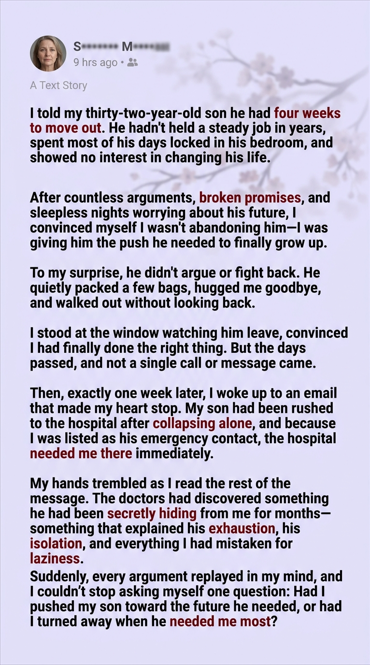
I told my thirty-two-year-old son he had four weeks to leave my house.
For years, I had watched him drift through life without a steady job, spending most of his days behind a closed bedroom door. He rarely went out, barely spoke to anyone, and seemed to have lost interest in everything.
I had tried being patient.
I had tried being strict.
I had offered to help him find work, encouraged him to take classes, and even arranged interviews through people I knew. Every time, something happened. He was too tired, too anxious, or simply didn’t show up.
Eventually, I stopped believing his promises.
I told myself I wasn’t helping him by allowing him to stay. He was thirty-two, and I was getting older. I couldn’t spend the rest of my life worrying about a son who refused to take responsibility for his own.
So one evening, after another argument about his future, I gave him an ultimatum.
“Four weeks,” I said. “You need to find somewhere else to live.”
He stood in the kitchen, looking at me.
For a moment, I expected him to argue.
Instead, he quietly nodded.
“Okay, Dad.”
That was all.
No shouting. No accusations. No promises that things would change.
He simply walked back to his room.
Over the next few weeks, I noticed him packing. He took only a few bags, some clothes, his laptop, and a small box of personal belongings.
I asked where he was going.
“Don’t worry. I’ll figure something out.”
I didn’t press him.
On the day he left, he came downstairs and placed his bags beside the front door.
He hugged me.
“Thanks for everything, Dad.”
I patted his back.
“Take care of yourself. It’s time to get your life moving.”
He gave me a small smile and walked away.
I watched from the window as he disappeared down the street.
Part of me felt relieved.
I thought perhaps this was exactly what he needed: a difficult decision that would finally force him to stand on his own feet.
But the days passed.
No phone call.
No message.
No update about where he was staying.
At first, I assumed he was angry with me. I told myself he needed space and that calling him would only make things worse.
Then exactly seven days after he left, my phone rang early in the morning.
It was an unfamiliar number.
“Am I speaking with Mr. Harris?” a woman asked.
“Yes.”
“My name is Laura. I’m a nurse at City General Hospital. Your son, Daniel, was brought in by ambulance last night. You’re listed as his emergency contact. We need you to come in as soon as possible.”
My coffee cup slipped from my hand.
“What happened? Is he okay?”
“He collapsed outside a convenience store. He’s receiving treatment, but the doctors would like to speak with you.”
I grabbed my keys without even changing out of my pajamas.
During the drive, my mind kept returning to the last time I had seen him.
His quiet goodbye.
His tired eyes.
The way he had hugged me longer than usual.
When I arrived, a nurse led me to a consultation room.
A doctor came in a few minutes later.
“Your son is stable,” he said. “But we discovered something during his examination that we need to discuss.”
I sat down.
“What’s wrong with him?”
The doctor opened a folder.
“Your son has severe iron-deficiency anemia. His blood count is dangerously low, and he has been experiencing symptoms for quite some time. We’re also investigating the underlying cause because his results suggest he may have been losing blood gradually.”
I stared at him.
“Anemia? Is that why he collapsed?”
“It likely contributed. But there are other concerns. He has been experiencing significant fatigue, dizziness, shortness of breath, and weakness. He told us these symptoms have been getting worse for several months.”
Several months.
I felt my stomach tighten.
The doctor continued.
“He’s also been losing weight. We need to determine why. His initial tests show signs of gastrointestinal bleeding, so we’re arranging further examinations.”
I struggled to understand.
“Why didn’t he tell me?”
The doctor paused.
“That’s something you’ll need to ask him. But he told our staff he hadn’t wanted to worry his family.”
I looked down at my hands.
For months, I had accused my son of being lazy.
I had complained about his sleeping habits, his lack of energy, and his unwillingness to leave his room.
I had told him he needed discipline.
I had never asked whether he was physically able to do the things I expected.
The doctor explained that my son would need further testing, treatment, and follow-up care. They couldn’t yet tell us the full cause, but they were taking the bleeding seriously.
Then he told me I could see him.
Daniel was lying in a hospital bed with an IV in his arm. His face looked pale, and he seemed smaller than I remembered.
When he saw me, he tried to smile.
“Hey, Dad.”
I pulled a chair beside him.
“What happened to you?”
He looked away.
“I guess I pushed myself too hard.”
“Why didn’t you tell me you were sick?”
He was quiet.
Then he whispered, “I tried.”
I felt my chest tighten.
“What do you mean?”
He looked at me.
“Remember when I told you I was tired all the time? When I said I couldn’t concentrate? When I told you I kept getting dizzy?”
I remembered.
Of course I remembered.
I had told him to stop making excuses.
He continued.
“I thought something was wrong, but I didn’t know what. I didn’t have health insurance for a while, and I was embarrassed to ask you for money. I kept thinking I’d get a job, save up, and see a doctor.”
I couldn’t speak.
He explained that he had started experiencing stomach pain and occasional bleeding months earlier. At first, he thought it was something minor. Then the exhaustion became so overwhelming that even taking a shower felt like hard work.
Some mornings, he woke up feeling as though he hadn’t slept at all.
He had stopped applying for jobs because he couldn’t make it through interviews without becoming dizzy or exhausted.
I stared at him.
“Why didn’t you tell me about the bleeding?”
He swallowed.
“Because every time I tried to explain how bad I felt, you told me I needed to stop being lazy. I didn’t want another argument.”
The words landed harder than anything I had ever heard.
I wanted to defend myself.
I wanted to explain that I had been worried, frustrated, and scared for his future.
But none of those explanations changed what he had experienced.
I had seen a son who wouldn’t get out of bed.
He had been living with symptoms he didn’t understand and was too ashamed to talk about.
Then he said something that broke me.
“When you told me to leave, I didn’t argue because I knew you were tired of me. I didn’t want to make things harder for you.”
I reached for his hand.
“Daniel, I never stopped loving you.”
He looked at me.
“I know, Dad. I just didn’t think you believed me anymore.”
I lowered my head.
For the first time, I understood that my son hadn’t interpreted my ultimatum as encouragement.
He had interpreted it as confirmation that he was unwanted.
I stayed with him that day while the medical team arranged further tests.
Over the next several days, doctors investigated the source of his blood loss. An endoscopic examination revealed an ulcer that had been bleeding intermittently. The doctors explained that it was treatable, but it had been left untreated for too long.
They began the appropriate treatment, monitored his blood levels, and helped him recover from the severe anemia. He also received nutritional support and a plan for follow-up care.
The doctor told me that his condition had likely been affecting his energy and concentration for months.
It didn’t mean every difficulty Daniel had faced was caused by his illness. But it explained far more than I had ever realized.
When Daniel was well enough to talk, I asked him why he had kept everything secret.
He told me he had been ashamed of being thirty-two and still living with his father. He felt he had failed at adulthood, and the more I criticized him, the harder it became to admit that he needed help.
He had also been afraid I would see his illness as another excuse.
I listened without interrupting.
Then I apologized.
Not the kind of apology that begins with “I’m sorry, but…”
I told him I was sorry for dismissing his exhaustion, for assuming I knew what was happening, and for making him feel that he had to leave before he could ask for help.
“I thought I was pushing you toward independence,” I said. “But I should have asked what was happening first.”
Daniel squeezed my hand.
“I should have told you, too.”
We both had things to learn.
After he was discharged, I offered to bring him home while he recovered.
He hesitated.
“Are you sure?”
I looked at him.
“You’re my son. Of course I’m sure.”
This time, we made a different plan.
His recovery came first. He attended his follow-up appointments, followed the doctor’s instructions, and gradually regained his strength. We also arranged counseling because the shame and isolation he had experienced hadn’t disappeared simply because his medical condition was being treated.
When he was ready, we discussed work and independence again.
But our conversations changed.
Instead of demanding that he immediately find a job, I asked what he felt capable of doing and what support he needed to get there.
He began exploring training opportunities and eventually found part-time work that allowed him to rebuild his confidence without pushing himself beyond his recovery.
It wasn’t an instant transformation.
There were difficult days, setbacks, and conversations we both struggled to have.
But we stopped treating every problem as a battle.
Months later, Daniel was sitting at the kitchen table when he looked up from his laptop.
“Hey, Dad?”
“Yeah?”
“Thanks for letting me come home.”
I put down my newspaper.
“You never had to earn the right to be my son.”
He smiled.
I still believe adults need responsibility. I still believe parents can’t solve every problem for their children forever.
But I learned that setting boundaries and showing compassion aren’t opposites.
I could have told my son he needed a plan for his future without making him feel that his place in my life depended on his ability to work.
I could have asked why he was sleeping so much instead of assuming he didn’t care.
I could have listened when he said he was exhausted.
The hospital call taught me something I wish I had understood sooner.
Sometimes what looks like laziness is a person struggling with something they don’t know how to explain.
And sometimes the most important thing a parent can do isn’t push harder.
It’s stop, sit beside their child, and ask:
“Are you really okay?”
I am grateful my son survived that night.
And I am grateful we still had time to begin again.