My Son Asked to Live With His Father—Then I Discovered What Was Happening Behind Closed Doors
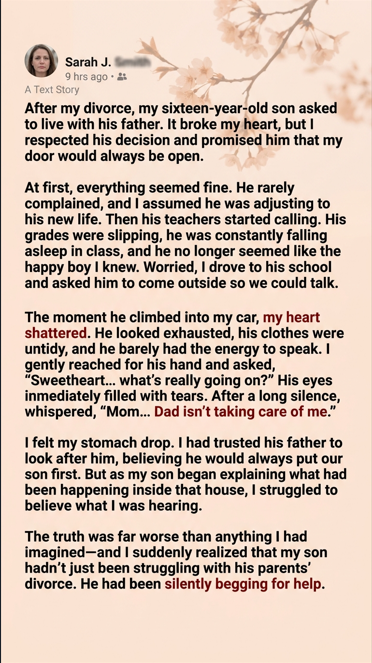
After my divorce, my sixteen-year-old son asked to live with his father.
It was one of the hardest conversations I’d ever had.
“Mom, I think I’d be happier at Dad’s house,” Ethan told me one evening.
I tried to keep my expression calm, even though something inside me cracked.
“Is that really what you want, sweetheart?”
He nodded. “His house is closer to school. And I think I need some time with him.”
I wanted to ask whether I’d done something wrong. I wanted to remind him that I’d spent sixteen years putting him first. But I knew he was old enough to have feelings and opinions of his own.
So I hugged him.
“If that’s what you want, I’ll support you. And remember, my door will always be open.”
His father, Mark, seemed pleased with the arrangement. He promised Ethan would have his own room, regular meals, help with homework, and everything he needed.
I believed him.
For the first few weeks, Ethan seemed fine. He sent occasional messages, answered my calls, and told me school was going okay.
I missed him terribly, but I didn’t want to make him feel guilty for choosing to live with his dad.
Then the school started calling.
His English teacher told me he had fallen asleep during a lesson. His math teacher said several assignments were missing. Another teacher mentioned that Ethan had become unusually quiet and seemed distracted.
At first, I thought it was the emotional stress of the divorce.
But the calls kept coming.
One afternoon, his guidance counselor asked whether anything had changed at home.
I couldn’t answer.
I had no idea what was happening in the house where my son lived.
The next morning, I drove to his school and asked the office to let him know I was outside.
When Ethan climbed into my car, I barely recognized the boy sitting beside me.
His hair was unwashed. His sweatshirt was wrinkled and stained. Dark circles sat beneath his eyes, and he looked so exhausted that even opening the passenger door seemed to take effort.
“Hi, sweetheart,” I said softly.
“Hey, Mom.”
I studied his face.
“Have you been sleeping?”
“Yeah.”
“Are you eating properly?”
He shrugged.
I reached for his hand.
“Ethan, please don’t tell me what you think I want to hear. What’s really going on?”
His eyes filled with tears.
For a long moment, he stared at his knees.
Then he whispered, “Mom… Dad isn’t taking care of me.”
My stomach dropped.
“What do you mean?”
He took a shaky breath.
“Dad leaves before I wake up. Sometimes he doesn’t come home until after midnight. He says I’m old enough to look after myself.”
I felt my throat tighten.
“What about dinner?”
“Sometimes there’s food. Sometimes there isn’t. He gives me money, but not enough for the whole week. I’ve been eating snacks from the vending machines at school.”
I looked at his thin face.
“Why didn’t you tell me?”
He wiped his eyes.
“Because I thought you’d be angry. I was the one who asked to live with him. I thought you’d say I deserved it.”
I turned toward him immediately.
“Ethan, listen to me. You never deserve to be neglected. Not for one second. You can make a decision that doesn’t work out, and you can still come home. You’re my son.”
He started crying harder.
Then he told me the rest.
His father had stopped washing his school clothes, so Ethan had been wearing the same few outfits repeatedly. The electricity had been disconnected twice because bills weren’t paid. He had missed a dentist appointment because his father forgot to take him.
Worst of all, Mark had begun leaving him alone overnight while going away with his girlfriend.
One night, Ethan had woken up with a fever and couldn’t reach his father. He had spent hours sitting on the bathroom floor, too frightened to call anyone because Mark had warned him not to “make problems.”
I was shaking with anger, but I knew my son needed comfort more than he needed to hear me shouting.
I pulled him into my arms.
“You should never have had to handle all of that alone.”
He rested his head against my shoulder.
“I didn’t want you to think I made the wrong choice.”
I kissed the top of his head.
“You are allowed to change your mind. You are allowed to need help. And you never have to earn your place in my home.”
That afternoon, I contacted his school counselor and explained what Ethan had told me. I also spoke with my attorney about the custody arrangement and made sure Ethan had a safe place to stay.
I didn’t simply drive him away from his father’s house and assume everything was fixed. We documented what had happened, involved the appropriate professionals, and arranged for Ethan’s immediate needs to be addressed.
When Mark finally called, he sounded irritated.
“Where is Ethan? He was supposed to come home.”
“He’s safe with me,” I replied.
“You can’t just take him.”
“I didn’t make him tell me what was happening. He came to me because he needed help.”
Mark insisted that Ethan was exaggerating and accused me of trying to turn him against his father.
I didn’t argue.
For once, I wasn’t interested in winning a fight with my ex-husband. I was interested in making sure our son was safe.
Over the following weeks, Ethan slowly began to recover.
He started sleeping through the night. His teachers noticed that he was paying attention again. He caught up on missing assignments, and we made a routine that included regular meals, homework time, and evenings when we could simply talk.
But the emotional damage didn’t disappear overnight.
Sometimes he apologized for needing new school clothes. Sometimes he asked whether I was upset that he had chosen his father.
Every time, I gave him the same answer.
“You never have to apologize for being my child.”
Eventually, Mark requested a meeting. He admitted that he had been overwhelmed and had spent more time away from home than he should have. He said he hadn’t realized how badly Ethan was struggling.
I listened, but I didn’t rush to excuse him.
Being overwhelmed did not make it acceptable to leave a teenager without reliable care.
Any future changes to the parenting arrangement would depend on Ethan’s well-being, consistent responsibility, and appropriate safeguards.
One evening, several months later, Ethan came into the kitchen while I was making dinner.
“Mom?”
“Yeah, sweetheart?”
“I’m glad I told you.”
I put down the spoon and turned toward him.
“I’m glad you did too.”
He hesitated before asking, “Were you hurt when I chose Dad?”
I took a breath.
“Of course I was. I missed you every day. But loving you means wanting you to feel safe and happy, even when your choices are difficult for me.”
He looked down.
“I thought you might not want me back.”
I crossed the kitchen and hugged him.
“There is nothing you could do that would make me stop being your mother.”
That night, I watched him sit at the table eating a warm meal, laughing at something on his phone, looking more like himself than he had in months.
I realized something important.
My son hadn’t chosen his father because he loved me less. He had simply hoped that living with his dad would give him something he needed.
And when that hope fell apart, he was afraid to admit it.
I had promised him that my door would always be open.
But I finally understood that the promise meant more than keeping a key available.
It meant making sure he never felt ashamed to knock.