My Tenant Suddenly Demanded to Speak to the “Real Landlord”—Then I Discovered Who Had Been Lying to Him
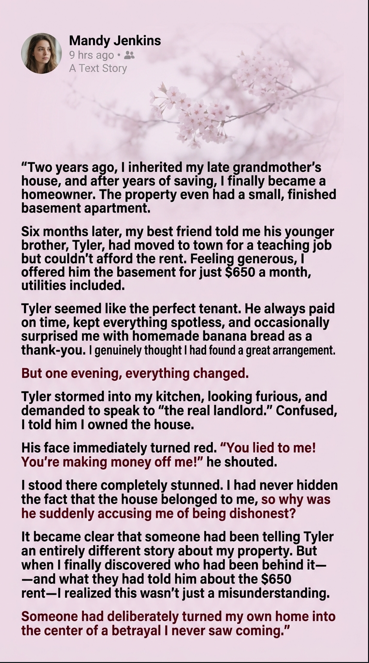
Two years ago, I inherited my late grandmother’s house.
It wasn’t a mansion, but it was the first place I could finally call my own. After years of saving, working overtime, and putting off everything I wanted, I had managed to turn her old property into a comfortable home.
The house even had a small finished basement apartment with its own entrance, bathroom, kitchenette, and bedroom.
Six months after moving in, my best friend, Jason, mentioned that his younger brother, Tyler, had moved to town for a teaching job.
“He’s having trouble finding somewhere affordable,” Jason explained. “Everything decent is ridiculously expensive.”
I knew how difficult it could be to start over in a new city, so I offered Tyler the basement apartment for $650 a month, utilities included.
He seemed grateful.
“Are you serious? That’s incredibly generous,” he said.
I explained that I owned the house, that the apartment was separate from my living space, and that $650 would cover his rent and utilities.
Tyler agreed immediately.
For the next six months, everything went smoothly. He paid on time, kept the apartment spotless, and never caused problems. Occasionally, I’d find a loaf of homemade banana bread on my kitchen counter with a little thank-you note beside it.
I genuinely thought I had found the perfect tenant.
Then one Thursday evening, everything changed.
I was making dinner when Tyler stormed into my kitchen without knocking.
“We need to talk to the real landlord,” he announced.
I turned around, confused.
“What?”
“The landlord. The actual owner of this property.”
I stared at him.
“Tyler, I own this house. You know that.”
His face turned red.
“Stop lying to me! You’re making money off me!”
I put down my spoon.
“I’m sorry, what?”
“You told me the rent was going toward the mortgage. You said the owner was an elderly woman who needed help paying the bills. But I found out you’re the one collecting the money!”
I felt as if the floor had shifted beneath me.
I had never told him anything about an elderly landlord. I had never claimed the rent went toward someone else’s mortgage.
“Who told you that?” I asked.
He crossed his arms.
“Jason.”
My best friend’s name hit me harder than the accusation itself.
Tyler explained that Jason had told him I was only managing the apartment for an older property owner. According to Jason, I wasn’t the real owner. I was supposedly collecting rent on someone else’s behalf and keeping a portion for myself.
Worse, Jason had apparently told him that the actual owner had no idea I was charging $650.
I stared at Tyler.
“Did you ever ask me about this?”
“He said you wouldn’t admit it because you didn’t want me going directly to the owner.”
I took a slow breath.
“Tyler, my grandmother left me this house. I have the inheritance documents. My name is on the deed. I told you that before you moved in.”
He looked uncomfortable.
“Jason said you were just saying that to make me feel better.”
I couldn’t believe what I was hearing.
I went to my office, pulled out the property documents, and showed him the deed.
Then I showed him the written rental agreement we’d both signed.
Tyler read everything twice.
His anger slowly turned into embarrassment.
“Why would Jason tell me that?”
That was the question I couldn’t stop thinking about.
The following morning, I called Jason.
He answered casually.
“Hey! What’s up?”
“Why did you tell Tyler I wasn’t the owner of my own house?”
There was a pause.
“What are you talking about?”
“Don’t pretend you don’t know. He came into my kitchen accusing me of collecting rent illegally because you told him I was only managing the property.”
Jason sighed.
“Look, I was just trying to help him understand the situation.”
“What situation? The one you invented?”
He became defensive.
“You’re charging your friend’s brother rent. I thought you could at least give him a better deal.”
I was stunned.
“He agreed to $650. He has his own apartment, utilities included, and a written agreement. What exactly did I do wrong?”
Jason hesitated.
Then he said something that made my stomach turn.
“You know what? I told him the rent was supposed to be $400. I said you were pocketing the extra $250.”
I went completely silent.
Jason continued, almost as if he were explaining something perfectly reasonable.
“I figured you’d split the difference with him once he found out. You’re not exactly struggling, and Tyler’s just starting his career.”
I gripped the phone.
“So you lied to him about the ownership, invented a different rent amount, and convinced him I was stealing from him?”
“Don’t make it sound so dramatic.”
“Why would you do that?”
He finally admitted that Tyler had been complaining about rent prices, and Jason thought he could pressure me into lowering the amount.
But there was another detail.
Jason had told Tyler that he would speak to me and get the rent reduced. When I didn’t do it, he decided to make me look dishonest so Tyler would confront me himself.
It wasn’t a misunderstanding.
It was a plan.
And Jason had used my trust, my home, and his own brother to carry it out.
I ended the call.
Later that day, Tyler came back to my kitchen. He looked genuinely ashamed.
“I’m sorry,” he said. “I should’ve come to you instead of believing him.”
I nodded.
“You should have. But I understand why hearing that from your own brother confused you.”
He looked down at the floor.
“I don’t want you thinking I was trying to take advantage of you.”
“I don’t think that. But I do need you to understand that this cannot happen again.”
We sat down and reviewed the rental agreement together. I explained exactly what the $650 covered: the private apartment, utilities, internet, and access to the laundry area. I also showed him the comparable rental prices in the neighborhood so he could understand how the arrangement had been set.
Tyler admitted that $650 was still affordable compared with the other places he’d considered.
“I’d like to stay,” he said. “If you’re comfortable with that.”
I agreed, but I made one condition: any questions about rent, ownership, or the property had to come directly to me. No more relying on stories passed through someone else.
Then I contacted Jason again.
This time, I was clear.
“You don’t get to use my house to manipulate your brother. And you don’t get to turn a favor I offered into a reason to accuse me of dishonesty.”
He tried to laugh it off.
“Come on. We’re friends.”
“Friends don’t invent lies to make each other look like criminals.”
He went quiet.
I told him I needed distance from him. I wasn’t interested in another argument or another explanation.
For several weeks, he sent messages claiming I had overreacted. Eventually, he stopped.
Tyler remained in the apartment and continued paying the agreed rent. He became more careful about checking information before believing it, and our arrangement returned to being peaceful.
A few months later, he brought me another loaf of banana bread.
This time, the note read:
“Thank you for giving me a place to start over. I’m sorry I let someone else’s lies make me forget who had actually helped me.”
I smiled when I read it.
I had inherited the house from my grandmother, but she had also left me something more important: a place where I could build a life and decide who deserved to be part of it.
I learned that being generous doesn’t mean letting people rewrite the truth about you.
And sometimes, the person who causes the biggest problem isn’t the stranger renting your basement.
It’s the friend who thinks your kindness gives him permission to interfere.