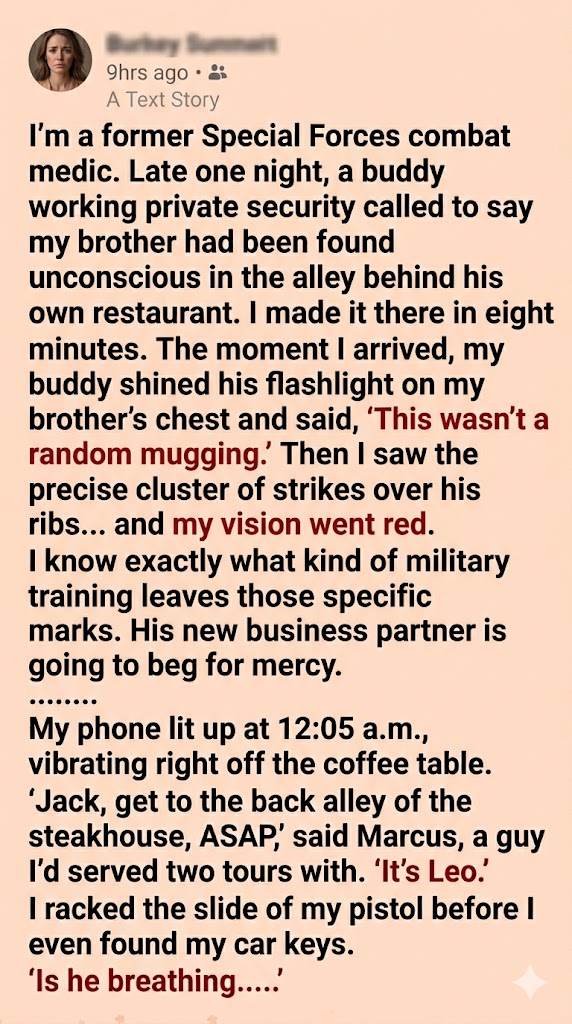
“Barely,” Marcus’s voice crackled through the speaker, tight and rigidly professional. “Pulse is thready. EMTs are three minutes out, but you need to see this before they load him up.”
I didn’t bother hanging up. I dropped the phone into the passenger seat, threw my truck into gear, and tore out of my driveway. The eight-minute drive was a blur of red lights run and rain-slicked asphalt. When you’re a former Special Forces medic, your brain is hardwired to compartmentalize panic. I shoved the image of my little brother bleeding out into a dark corner of my mind and engaged the sterile, clinical focus that had kept men alive in the mountains of Kunar Province.
I skidded to a halt at the mouth of the alley behind The Ironwood, Leo’s pride and joy. The flashing strobes of an ambulance were already painting the brick walls red and white.
Marcus was standing over a stretcher, his broad shoulders tense. He caught my eye and subtly shook his head, stepping back so I could get a look before the paramedics strapped the oxygen mask over Leo’s face.
Leo was pale, his breathing a shallow, ragged wet sound that I recognized instantly: a compromised pleural cavity. My hands moved on instinct, checking his pulse, assessing the trauma. Then, Marcus clicked on his heavy-duty flashlight, aiming the harsh beam directly at Leo’s exposed torso.
“This wasn’t a random mugging, Jack,” Marcus said quietly over the hum of the idling ambulance.
I stared at the bruising, and the cold, clinical part of my brain vanished, replaced by a blinding, white-hot fury.
There were four distinct, perfectly spaced contusions clustered over Leo’s lower left floating ribs. They weren’t from a bat, and they weren’t from a wild street brawl. They were precise, calculated strikes designed to bypass the skeletal structure, shock the vagus nerve, and hemorrhage the spleen without leaving a bloody scene. It was a compliance and neutralization technique. I had only ever seen it taught in a classified Tier 1 close-quarters combat syllabus.
“Vance,” I whispered.
Victor Vance was Leo’s new “silent investor.” He had pitched himself as a venture capitalist who specialized in hospitality turnarounds. When I first met him, I noticed the way his eyes scanned exits and how he stood bladed away from doors. I’d warned Leo, but my brother was a chef, not a soldier. He saw a lifeline for his struggling business; I saw a wolf in a tailored suit.
“Paramedics are rolling him out,” Marcus said, grabbing my shoulder. “What do you need me to do?”
“Go to the hospital. Do not let anyone into his room who isn’t wearing a badge and a stethoscope. If Vance sends a cleaner to finish the job, put them in the morgue.”
“Copy that. And you?”
“I’m going to have a chat with the venture capitalist.”
I slipped through the back door of the restaurant. The kitchen was dark, smelling faintly of char and rosemary. I moved silently up the back stairwell toward the executive office. Vance wouldn’t have fled yet. Arrogance was the fatal flaw of guys with his specific background; he’d assume Leo was dead in an alley and that he had plenty of time to cook the books, drain the operating accounts, and vanish by morning.
I bypassed the electronic keypad on the office door by slipping my tactical knife into the strike plate, jimmying the latch with a quiet click.
Vance was sitting at Leo’s mahogany desk, illuminated only by the glow of a laptop screen. He was transferring files, a suppressed pistol resting casually next to his mousepad.
He didn’t even have time to reach for it.
I crossed the room in three strides. Before he could turn his head, I slammed the heel of my palm into the side of his neck, striking the brachial plexus. His right arm went instantly numb, dropping uselessly to his side. I grabbed a fistful of his expensive silk tie, hauled him out of the leather chair, and drove him crashing over the top of the desk.
Computers and paperwork scattered across the floor as he hit the hardwood. To his credit, Vance recovered fast. He rolled, sweeping a leg out to drop me, but I stepped inside the guard, bringing my knee down hard into his sternum.
He gasped, his eyes widening as he stared up at me. Recognition dawned, followed quickly by the realization that he had made a catastrophic miscalculation.
“Jack,” Vance wheezed, trying to mask his panic with a bloody smirk. “You’re upset. Let’s talk about—”
“You hit him with a quad-strike to the false ribs,” I said, my voice dead flat. “You ruptured his spleen and partially collapsed his left lung.”
I reached down and grabbed him by the lapels, lifting him just enough so we were eye to eye.
“The problem with guys like you, Vance, is that you only learn how to break a body.” I shifted my grip, pressing my thumb into a very specific cluster of nerves under his collarbone. He let out a choked, agonizing scream as his entire upper torso locked up in pain. “I’m a combat medic. I spent eight years learning how to put bodies back together. Which means I know exactly where every nerve, every artery, and every pain receptor in your body is. And I know exactly how much pressure it takes to make you wish you were dead without actually letting you die.”
I leaned in closer, letting him see the absolute absence of mercy in my eyes.
“Now,” I whispered. “You’re going to transfer every dime back into Leo’s accounts. Then, you’re going to write a very detailed confession for the police about your little extortion racket. If you hesitate, or if you miss a single comma…”
I pressed a fraction of an inch deeper into the nerve cluster. Vance thrashed, his eyes rolling back in his head.
“I’ll start taking you apart. Piece by piece.”