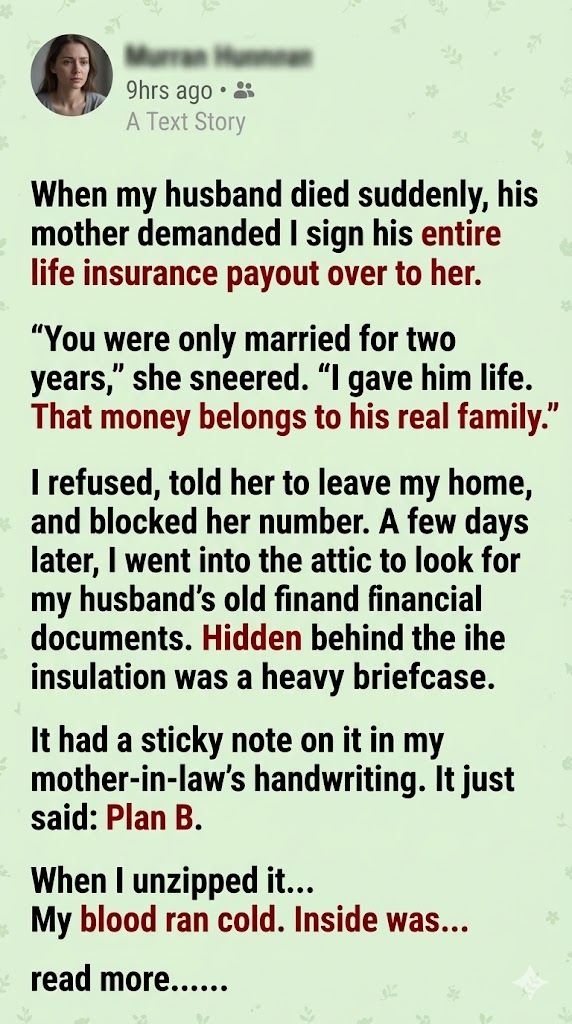
My blood ran cold. Inside was a meticulously organized dossier, and it wasn’t about my husband’s finances. It was about me.
Spread across the red velvet lining of the briefcase were dozens of high-resolution photographs of my daily routine: my car parked at work, me picking up groceries, the view of our living room window from the street. But the photos were just the beginning.
Beneath them lay a stack of heavy, watermarked paper. I pulled the first sheet out with trembling fingers. It was a forged will, supposedly written by me, naming my mother-in-law, Helen, as the sole beneficiary of my estate—including my husband’s life insurance policy.
Underneath that was a typed note, signed with an exact replica of my signature.
“I can’t live with the guilt of what I did to Mark. I’m so sorry. I hope Helen can forgive me.”
Panic seized my chest. Mark’s death had been ruled a sudden, massive heart attack. He was thirty-two and a runner. The doctors were baffled, but chalked it up to an undiagnosed congenital defect.
Tucked into the corner of the briefcase, nestled in a custom-cut foam insert, was the final piece of “Plan B”: a small, empty glass vial of a concentrated digitalis derivative—a drug known to cause fatal, untraceable cardiac arrest if administered in the right dose. Beside it lay a loaded syringe and a spare key to my back door.
Helen didn’t just want the money. She had murdered her own son for the payout, and when I refused to hand it over, her backup plan was to frame me for his death and stage my suicide to get it anyway.
A sudden, sharp crunch of tires on gravel snapped me out of my horror.
I crept to the small attic window and peered through the dust-caked glass. Helen’s dark silver sedan was idling in my driveway. The driver’s side door clicked open, and she stepped out, wearing a pair of tight, black leather gloves.
My heart hammered against my ribs. I had blocked her number, but I hadn’t changed the locks yet. I heard the faint, metallic scrape of a key sliding into the back door downstairs.
I didn’t scream. I didn’t freeze. Survival instinct, sharp and sudden, took over. I grabbed the briefcase, pulled my phone from my pocket, and dialed 911, whispering my address to the dispatcher before sliding the phone under a floorboard to keep the line open.
I heard the heavy thud of her footsteps on the hardwood floor below.
“Sarah?” her voice drifted up the stairs, sickly sweet and dripping with false concern. “Sarah, darling? I came to apologize. I brought tea.”
I backed into the darkest corner of the attic, clutching the briefcase to my chest like a shield. I could hear the slow creak of the stairs as she began to climb. I scanned the dim space for a weapon, my hand closing around the heavy iron base of a broken floor lamp.
Just as the attic doorknob began to turn, a deafening siren wailed down the street, cutting through the silence of the house. The doorknob violently snapped back into place. Heavy footsteps rushed down the stairs, followed by the shattering of glass and a frantic scuffle in the kitchen.
When the police finally came up to find me, I handed the detective the leather briefcase. They had caught Helen trying to sprint through the backyard, a thermos of poisoned tea dropped and shattered on the patio.
The life insurance money eventually cleared. I used a portion of it to hire the best prosecuting attorneys in the state. Helen will spend the rest of her life in a maximum-security prison, and I sold the house, leaving the state to start over. She thought she gave him life, but she was the one who took it away—and she almost took mine, too.