The first time I saw my wife’s dating profile, I thought my marriage had ended without me.
There was her photograph.
The one we’d taken on a beach vacation three years earlier.
She’d cropped me out.
Her profile was short.
Loves hiking. Coffee addict. Looking for a fresh start.
Nothing about being married.
Nothing about our home.
Nothing about me.
I refreshed the page three times, convinced I had clicked on the wrong person.
I hadn’t.
I sat at my desk long after midnight staring at the screen.
Emily was asleep upstairs.
Or at least I assumed she was.
The next morning, she kissed me goodbye before leaving for work.
“Love you.”
“You too.”
The words tasted strange.
For the next two days, I tried convincing myself there had to be an explanation.
Maybe an old account.
Maybe someone using her pictures.
Then I saw the “last active” timestamp.
Twenty-three minutes earlier.
My stomach dropped.
Against my better judgment, I created a fake profile.
Nothing elaborate.
Just enough to start a conversation.
She responded that same evening.
The messages began innocently.
Favorite books.
Travel.
Music.
Then, four days later, I asked the question I’d been dreading.
“Were you ever married?”
She replied almost immediately.
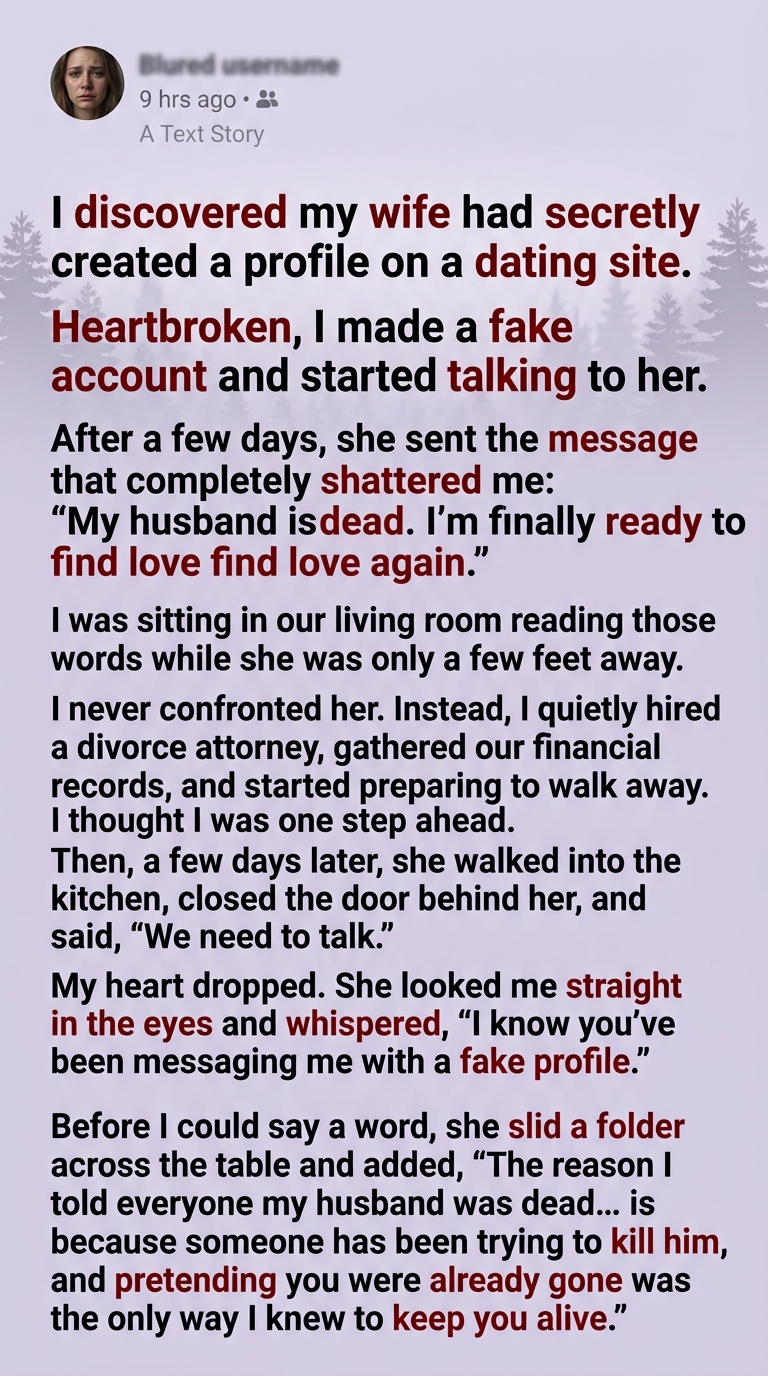
My husband is dead.
I’m finally ready to find love again.
I read those words while sitting on the living room couch.
Emily was only a few feet away, curled up in an armchair reading a novel.
She looked peaceful.
Comfortable.
As though she hadn’t just told a complete stranger that I no longer existed.
Something inside me broke.
I didn’t confront her.
I didn’t yell.
I simply called a divorce attorney the following morning.
Her name was Rachel Foster.
She gave me one piece of advice before anything else.
“Don’t make life-changing decisions in the first forty-eight hours after a painful discovery.”
So I waited.
While waiting, I quietly gathered tax returns, bank statements, mortgage records, retirement account information, and insurance documents.
Everything was copied.
Everything stayed exactly where it belonged.
I wanted facts.
Not revenge.
A week later, I believed I was ready.
Then everything changed.
It was a Wednesday evening.
Emily walked into the kitchen carrying two mugs of tea.
She closed the door behind her.
Locked it.
My pulse quickened.
She placed one mug in front of me.
Then she looked directly into my eyes.
“We need to talk.”
Every prepared speech disappeared from my mind.
She reached into her bag.
Pulled out a folder.
Set it on the table.
“I know you’ve been messaging me.”
The room spun.
“The fake profile.”
I couldn’t deny it.
“I’m sorry.”
She surprised me by shaking her head.
“No.”
“I’m sorry.”
Before I could respond, she slid the folder toward me.
“The reason I told people my husband was dead…”
“…is because someone has been trying to kill him.”
I stared at her.
She didn’t smile.
Didn’t blink.
Didn’t look as though she expected me to believe something outrageous.
She simply looked exhausted.
“Emily…”
“I know how impossible this sounds.”
“It does.”
“I also know exactly what you’re thinking.”
She opened the folder.
Inside were copies of police reports.
Security-camera photographs.
Insurance documents.
A newspaper clipping from six months earlier.
The headline caught my attention immediately.
Accountant Testifies in Major Financial Fraud Investigation.
The photograph beneath the headline showed…
Me.
I frowned.
“I remember this.”
“You testified.”
“I did.”
Almost a year earlier, I’d testified as a forensic accountant in a federal fraud case involving a real-estate investment company. My role had been limited to explaining financial records I’d analyzed for investigators.
The trial ended months ago.
I assumed everyone had moved on.
Emily quietly said,
“They didn’t.”
She handed me another document.
A police incident report.
Three months earlier, someone had slashed all four tires on my car.
We’d both assumed it was random vandalism.
Then another report.
Someone had entered our backyard at night.
Nothing stolen.
Just footprints.
Then another.
A photograph of our mailbox.
Destroyed with a baseball bat.
I looked at her.
“Why didn’t you tell me the police connected these?”
“Because they didn’t.”
“What?”
“They couldn’t.”
“The incidents weren’t enough by themselves.”
“So why would you think they’re connected?”
She swallowed hard.
“Because someone contacted me.”
My chest tightened.
She unlocked her phone.
Opened a folder.
There were screenshots of anonymous messages.
Tell your husband to stop talking.
Witnesses disappear every day.
Widows heal eventually.
The first message had arrived two weeks after the trial.
My hands started shaking.
“Why didn’t you come to me?”
“I wanted to.”
“Then why didn’t you?”
“The detective handling the harassment investigation believed the sender wanted exactly that.”
“What?”
“They believed whoever was sending the messages wanted to measure your reaction.”
“If we immediately changed routines…”
“…they’d know the threats reached us.”
I stared at her.
“So the dating profile…”
She nodded.
“The detective suggested something unusual.”
“If someone believed you were already gone—or that I’d completely moved on—they might lose interest in watching our house.”
I frowned.
“That doesn’t explain telling strangers I was dead.”
“It wasn’t strangers.”
She turned the screen toward me.
Every profile she’d interacted with had been identified by investigators as likely fake accounts created within days of each other.
The detective believed someone was attempting to gather information through casual online conversations.
Emily’s profile had been created with law enforcement’s knowledge as part of documenting those contacts.
“I wasn’t looking for dates.”
“I was documenting who kept asking about you.”
I sat in stunned silence.
“Then why keep it from me?”
She looked down.
“Because you would never have agreed.”
She was probably right.
“And because if you knew…”
“…you couldn’t honestly respond if someone questioned you.”
I leaned back.
None of this felt real.
She quietly added,
“The moment your messages became personal…”
“…I recognized your writing.”
I blinked.
“You did?”
“You always use two spaces after a period.”
I laughed despite myself.
“I’ve told you for years nobody notices that.”
“I notice.”
She smiled weakly.
“I knew it was you after the third message.”
“So why keep answering?”
“I needed to know whether you’d confront me.”
“I almost did.”
“I know.”
She reached across the table.
“I’m sorry I made you doubt everything.”
“I’m sorry I assumed the worst.”
The next morning, Emily asked whether I would finally meet Detective Carla Mendoza.
The detective spread the case file across her desk.
Much of what Emily had shown me was there, along with details she hadn’t shared because investigators had asked her not to.
The anonymous messages had originated from disposable accounts linked to devices already under investigation in connection with witness intimidation.
The dating profile had never been intended to lure anyone into a relationship. It had become one small part of documenting suspicious contacts while officers tried to identify who was behind them.
“There was never a guarantee this strategy would work,” Detective Mendoza said. “It was one of several investigative steps, and we understand why keeping it from you caused pain.”
Months later, investigators arrested two people for witness tampering and related offenses.
The threats stopped.
Life slowly returned to something resembling normal.
Not immediately.
Secrets—even well-intentioned ones—leave scars.
Emily and I began counseling.
One evening our counselor asked a question neither of us had considered.
“What have you learned?”
Emily answered first.
“Protecting someone shouldn’t mean carrying every burden alone.”
I nodded.
“And fear can make honest people keep devastating secrets.”
The counselor smiled gently.
“So next time…”
Emily squeezed my hand.
“There won’t be a next time.”
I looked at her.
“If either of us thinks we’re protecting the other by hiding something this big…”
“…we ask for help before we decide alone.”
She nodded.
“Deal.”
Years later, I deleted the fake dating profile I’d once created out of heartbreak.
Not because it reminded me of betrayal.
Because it reminded me how easily incomplete information can become a story that feels unquestionably true.
Sometimes people lie because they’re selfish.
Sometimes they lie because they’re afraid.
Neither kind of lie is harmless.
But understanding the difference can determine whether a relationship ends with anger…
…or survives long enough for the truth to finally be told.