The Architect’s Leverage
The email subject line read: URGENT – STRICTLY CONFIDENTIAL – Board of Directors, VanceTech Industries.
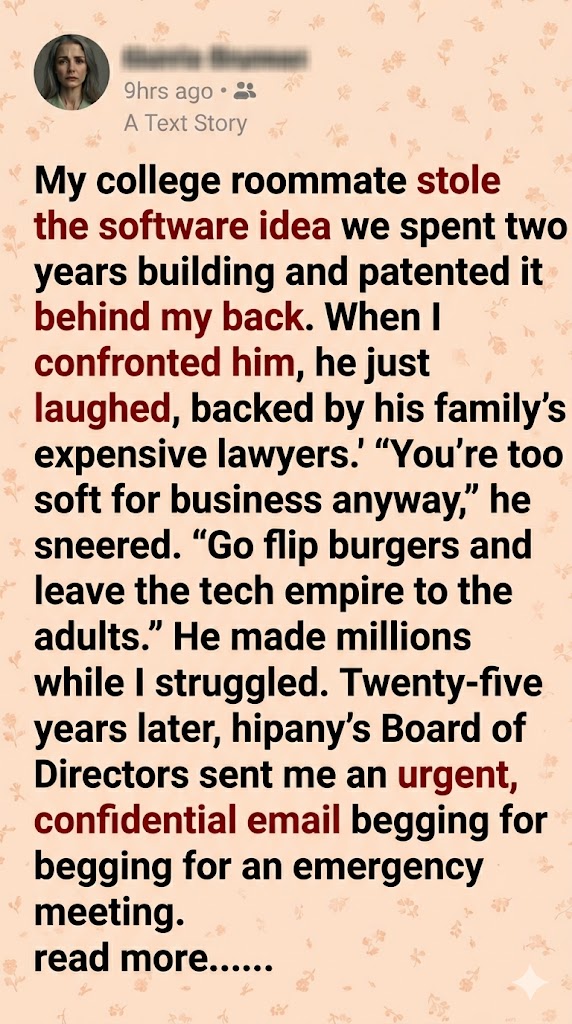
I stared at the screen, the glow reflecting off the quiet, minimalist office I’d built for myself over the last two decades. Twenty-five years ago, Marcus Vance had taken my life’s work, slapped his family’s name on the patent application, and locked me out of our dorm. I had spent my twenties eating ramen and fighting off depression while he rang the opening bell at the New York Stock Exchange.
“Go flip burgers,” he had sneered.
I didn’t. Instead, I quietly went back to the drawing board.
When I walked into the VanceTech boardroom the next morning, the tension was thick enough to choke on. The glass-walled room overlooked the city skyline—a gleaming testament to the empire built on my stolen late nights and endless lines of code. Marcus sat at the head of the table. He looked older, the arrogant smirk replaced by a tight, pale grimace. Flanking him were eight board members looking absolutely terrified.
“Thank you for coming,” the Chairman, a severe-looking woman, said, gesturing to an empty leather chair. “I’ll be blunt. VanceTech Core is collapsing.”
VanceTech Core. The evolution of my original software. It now ran the logistics for half the country’s financial supply chain.
“As we scale to our new cloud infrastructure, the foundational architecture is fracturing,” she explained, her voice tight. “Our engineers can’t patch it. The original legacy code has a deeply embedded structural logic that…” She paused, glaring at Marcus with visible disgust. “…that our CEO apparently does not understand. He finally admitted you were the sole architect. If it fails, we face billions in liability. The company will not survive the week.”
Marcus slammed his hand on the table. “Just pay him! Give him five million dollars, let him fix the legacy bugs, and get him out of here!”
I didn’t look at Marcus. I kept my eyes calmly on the Chairman. I opened my briefcase and slid a single, thick folder across the mahogany table.
“I’m not here for a consulting fee,” I said, my voice quiet but carrying perfectly across the room.
The Chairman opened the folder. Her eyes widened.
Over the past twenty-five years, I hadn’t just moved on. I had built Aegis, a highly specialized, quiet B2B infrastructure company. I knew the fatal flaw in my original code—I had discovered it the week before Marcus stole the hard drives. I knew that one day, when the data load hit a massive, modern threshold, the entire system would bottleneck and shatter. So, I spent two decades building the exact technological bridge required to save it.
“That is an acquisition contract,” I told the silent room. “My company will absorb VanceTech’s failing infrastructure and migrate your clients to my secure network.”
“You’re out of your mind!” Marcus shouted, his face turning purple as he stood up. “I’m the founder! I’m the majority shareholder! I’ll never sell to you!”
“You don’t have a choice, Marcus.” I finally turned to look at him. “Read page four. The cost of my migration tech—the only thing that will save you from federal prison for gross negligence—is exactly the valuation of your voting shares. You’re going to sign them over to me. Today. And you’re going to step down as CEO.”
The boardroom was dead silent. The Chairman looked at the technical audit I’d provided, then at the company’s bleak internal projections. She nodded slowly. The rest of the board followed suit. They were trapped, and they knew it.
Marcus slumped back into his chair, the blood draining from his face as his empire crumbled in a matter of seconds. He looked at me, no longer the untouchable billionaire, just a thief who had finally reached the limits of what he could fake.
I stood up and buttoned my jacket.
“You were right about one thing, Marcus,” I said softly, walking toward the heavy glass doors. “I was too soft for business back then. But I grew up. And I think it’s time you leave the tech empire to the adults.”