The College Fund He Thought He Could Steal
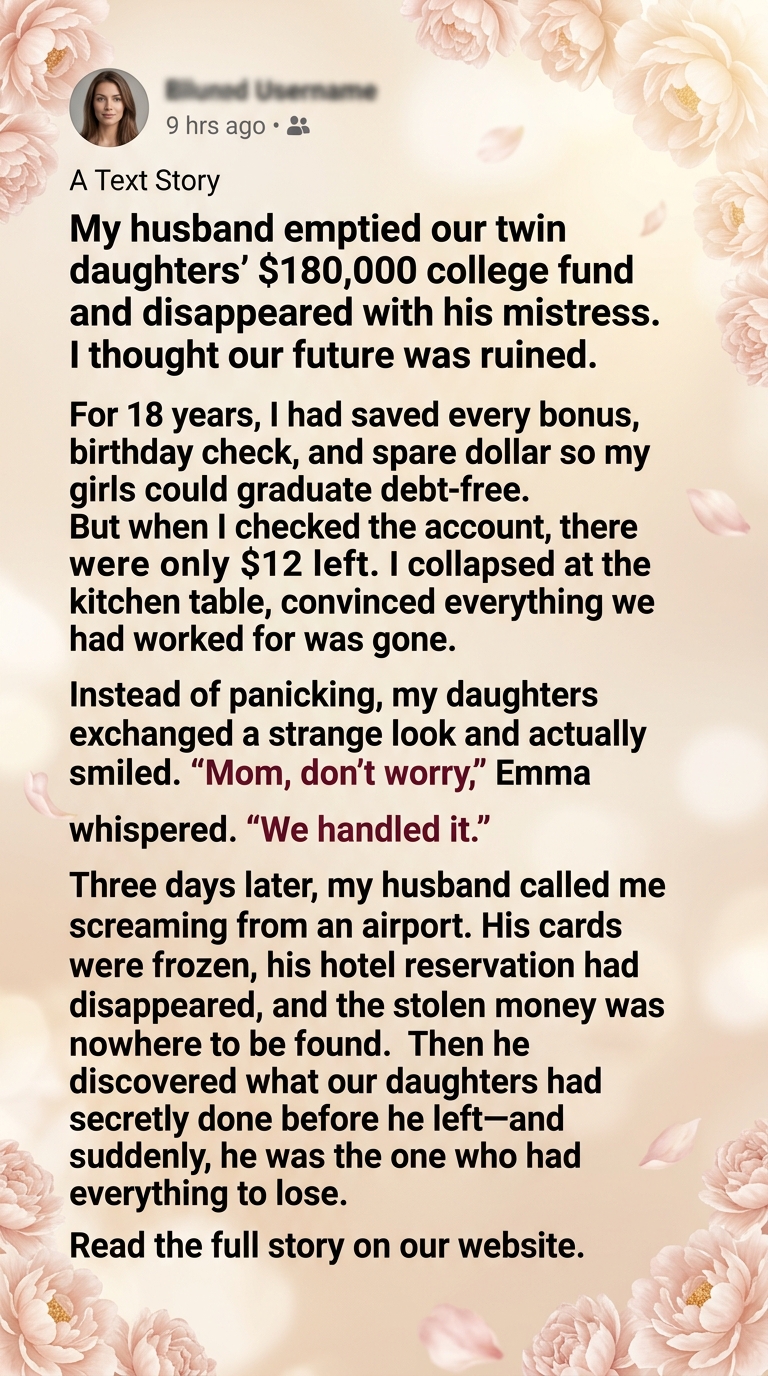
My husband emptied our twin daughters’ college fund and disappeared with his mistress.
For eighteen years, I had saved for my girls.
Every bonus.
Every birthday check.
Every tax refund.
Every spare dollar I could put away went into that account.
My dream was simple: when Emma and Emily graduated, they wouldn’t have to begin adulthood buried under student loans.
Then one Friday morning, I checked the account.
There was $12 left.
I stared at the screen.
Then I checked again.
$12.47.
The $180,000 we had saved was gone.
I collapsed at the kitchen table.
My hands were shaking so badly I could barely hold my phone.
My husband had taken everything.
And he was gone.
He had left with another woman.
I felt humiliated.
Angry.
Terrified.
I kept thinking about my daughters.
Eighteen years of saving had disappeared overnight.
I thought about their college applications.
Their dreams.
Everything we had promised them.
I expected Emma and Emily to panic when I told them.
Instead, they exchanged a strange look.
Then they smiled.
“Mom,” Emma said quietly.
“Don’t worry.”
Emily reached across the table and squeezed my hand.
“We handled it.”
I stared at them.
“What do you mean?”
They wouldn’t explain.
Not yet.
Three days later, my husband called me.
He was screaming.
His cards had been frozen.
His hotel reservation had disappeared.
The bank accounts he thought he could access were suddenly restricted.
And the money he had stolen wasn’t where he expected it to be.
“You did this!” he yelled.
“I don’t know what you’re talking about.”
“Where is my money?”
I almost laughed.
“Your money?”
“It was in our account!”
“No,” I said. “It was our daughters’ college fund.”
He hung up.
Then called again.
This time, he sounded frightened.
“Your daughters did something.”
I looked at Emma and Emily.
They were standing behind me.
“Yes,” I said.
“What did they do?”
I smiled.
“Ask them.”
I handed the phone to Emma.
She put it on speaker.
“Dad,” she said calmly.
“You should have checked the account before you took the money.”
There was silence.
Then my husband said:
“What did you do?”
Emily answered.
“We’ve been preparing for college since we were sixteen.”
She explained that two years earlier, they had become suspicious when Dad started asking unusual questions about the college fund.
So they began learning about how the account was structured.
They discovered that although I had contributed most of the money, the account had specific protections because it was established for their education.
They also noticed something else.
Dad had been trying to gain control of it.
That’s when they made a plan.
With my knowledge and the advice of a financial professional, they moved the college savings into properly protected education accounts in their own names, where permitted, while keeping detailed records of every contribution.
They didn’t tell their father.
They wanted to see what he would do.
And he eventually showed them.
The money he had taken wasn’t the entire college fund.
It was money he had transferred from a separate account using information he believed would give him access.
The twins had already documented the transfers.
They had alerted the bank.
And they had contacted an attorney.
My husband had assumed he had stolen $180,000.
He hadn’t.
He had created evidence of financial misconduct against himself.
And there was something else.
Emma had saved screenshots of every suspicious message she had seen between him and his mistress.
Emily had downloaded copies of financial statements before he left.
They had documented the date he disappeared.
They had even saved the airline confirmation he had accidentally left on the family computer.
My husband had been planning to leave for months.
He thought he was getting away clean.
Instead, he had left a trail.
The attorney filed the necessary paperwork.
The bank froze the remaining accounts.
The stolen funds were traced.
The financial records were turned over to investigators.
And because the money had been earmarked for our daughters’ education, the situation became much more serious than my husband expected.
He eventually returned part of the money.
The rest was recovered through the legal process.
It took months.
There were meetings.
Documents.
Court hearings.
Arguments.
There were nights when I was exhausted from trying to keep everything together.
But my daughters never let me give up.
One evening, I asked them why they had stayed so calm that first morning.
Emily smiled.
“Because Dad thought he was stealing our future.”
Emma finished her sentence.
“But he didn’t know we’d already learned how to protect it.”
I started crying.
“You two shouldn’t have had to handle any of this.”
Emily hugged me.
“We didn’t do it alone, Mom.”
She pointed toward me.
“You taught us how to save.”
“You taught us to keep records.”
“You taught us not to panic when things go wrong.”
I laughed through my tears.
“I didn’t teach you how to deal with a cheating husband.”
Emma smiled.
“No.”
“But we learned that one ourselves.”
Eventually, the divorce was finalized.
My husband lost far more than the money he had tried to steal.
He lost his marriage.
He lost his relationship with our daughters.
And he lost the trust of everyone who had once believed he was a decent man.
The twins went to college.
They graduated without the mountain of debt I had feared.
On graduation day, I sat in the audience and watched them walk across the stage.
When they received their diplomas, I cried.
Not because of the money.
Because eighteen years of saving had never really been about the money.
It had been about giving them choices.
A future.
A chance to start adulthood without being trapped by someone else’s mistakes.
After the ceremony, Emma hugged me.
“Remember when you thought everything was gone?”
I smiled.
“I do.”
She looked at her sister.
“Good thing we didn’t.”
Emily laughed.
That night, I went home and opened the old account where I had once watched their college fund grow.
The balance was no longer $180,000.
It was almost empty.
But for the first time, I didn’t feel devastated.
Because the money had done what I had always wanted it to do.
It had given my daughters a future.
And my husband had taught them something no amount of money could buy:
Never trust someone simply because they share your last name.
Trust is earned.
Money can be replaced.
But once trust is broken, it may never come back.
My husband thought he had taken everything from us.
He was wrong.
He took money.
He didn’t take our future.
He didn’t take our family.
And he certainly didn’t take my daughters’ determination to build lives without him.
Three days after he ran away, he called screaming from an airport.
He thought he was the one who had everything to lose.
He was right.
But he was wrong about what mattered.
Because in the end, the twins didn’t just save their college fund.
They saved their future.