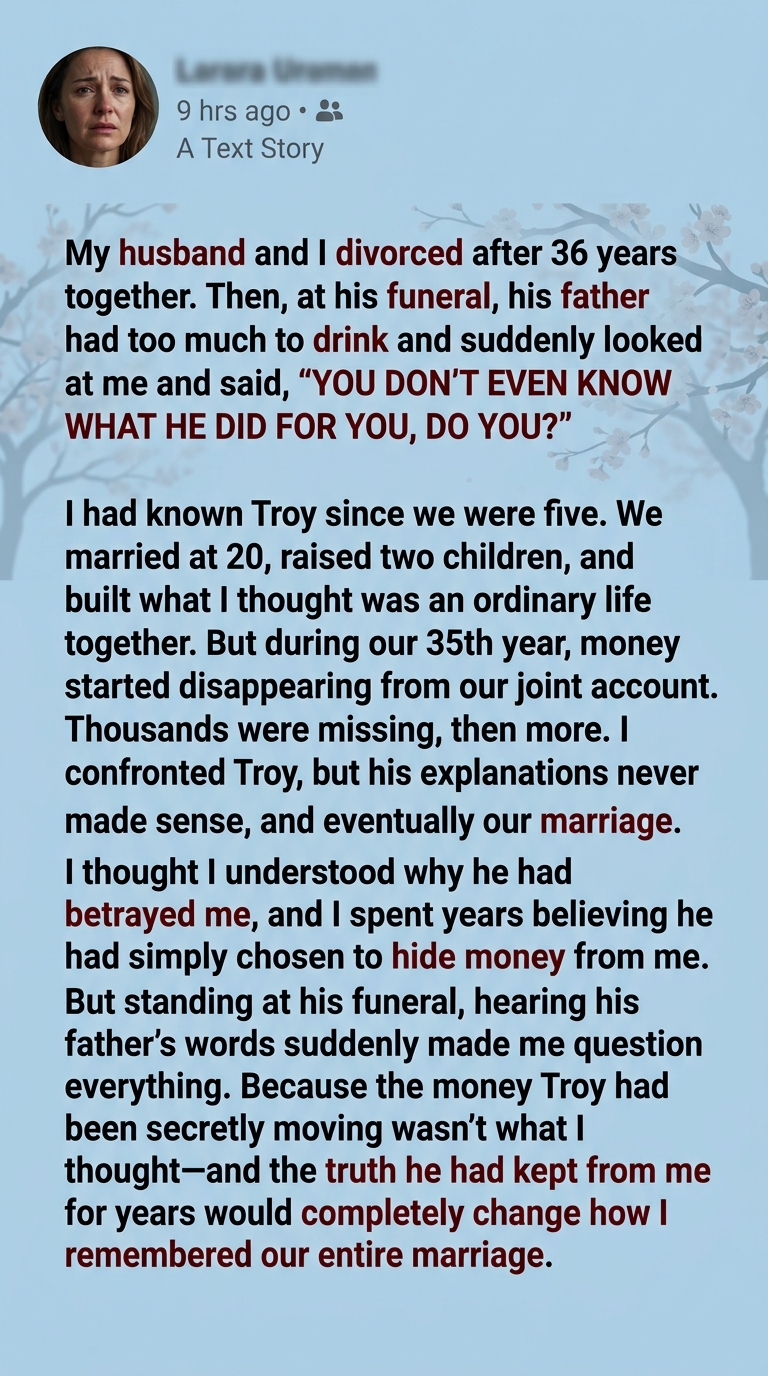
I had known Troy since we were five years old.
We grew up on the same street.
Went to the same school.
Played together as children.
By the time we were teenagers, everyone assumed we’d eventually end up together.
They were right.
We got married at twenty.
We had two children.
We bought a house.
Paid bills.
Argued about money.
Went on vacations when we could afford them.
Raised our kids.
Then became grandparents.
For thirty-five years, I thought I knew my husband.
Then everything changed.
It started with money.
One morning, I checked our joint account and noticed several thousand dollars missing.
I asked Troy about it.
“It’s nothing.”
“What does that mean?”
“I moved some money.”
“Where?”
“Somewhere safe.”
I frowned.
“Why?”
He wouldn’t answer.
At first, I assumed it was some financial mistake.
Then more money disappeared.
Thousands became tens of thousands.
Every time I confronted him, he had another explanation.
Investments.
Taxes.
Business expenses.
Things I didn’t understand.
I asked to see the accounts.
He refused.
That was when I knew something was seriously wrong.
After thirty-five years of marriage, I couldn’t understand why my husband was hiding money from me.
I felt betrayed.
Then I found another account.
It contained nearly $80,000.
Troy had never mentioned it.
I confronted him.
He became defensive.
“I was going to tell you.”
“When?”
“When the time was right.”
“What time?”
He didn’t answer.
The arguments became constant.
Trust disappeared.
Eventually, we divorced.
After thirty-six years together, our marriage ended because I believed my husband had been secretly protecting money from me.
I told myself he had changed.
Maybe he’d fallen in love with someone else.
Maybe he’d wanted a life without me.
Maybe he’d simply stopped caring.
I never got a satisfying answer.
Years passed.
Then Troy died.
We had been divorced for several years by then.
But hearing the news still hurt.
He had been my husband for most of my adult life.
The father of my children.
The person whose face had been beside mine in thousands of photographs.
I went to his funeral.
His father was there.
Troy’s father had always been a quiet man.
But that afternoon, he’d been drinking.
Too much.
At the reception, he suddenly looked at me.
His eyes were red.
His voice was shaking.
Then he said the words that changed everything.
“YOU DON’T EVEN KNOW WHAT HE DID FOR YOU, DO YOU?”
I stared at him.
“What are you talking about?”
He shook his head.
“You never asked.”
“I asked him constantly.”
“No.”
He stepped closer.
“You asked where the money went.”
“Yes.”
“You never asked why.”
I felt a chill.
“What do you mean?”
He looked at me.
“Troy wasn’t hiding money from you.”
I laughed bitterly.
“Then what was he doing?”
His father leaned toward me.
“He was protecting you.”
I couldn’t speak.
“From what?”
He didn’t answer immediately.
Instead, he asked,
“Do you remember the car accident twenty years ago?”
Of course I remembered.
Our son had been seventeen.
He had been driving home from work when another driver hit him.
Our son survived.
But the medical bills had been enormous.
Insurance covered most of it.
Or so I thought.
Troy’s father continued.
“There was something you never knew.”
I stared at him.
“Troy was sued.”
“What?”
“The other driver’s family claimed he was responsible.”
My stomach tightened.
“But he wasn’t.”
“I know.”
“He wasn’t even driving.”
“I know.”
“Then why?”
His father explained.
The other driver’s insurance company had tried to shift blame.
They threatened a lawsuit.
Troy had been terrified.
Not because he thought he’d lose.
Because he was afraid that if the case went badly, everything we’d built could disappear.
The house.
Our savings.
Our children’s future.
So Troy had quietly started moving money.
Not into another woman’s account.
Not into some secret life.
Into a protected account established through an attorney.
An account designed to shield our family assets if the lawsuit escalated.
I felt dizzy.
“But why didn’t he tell me?”
His father looked at me.
“Because he knew you’d panic.”
I shook my head.
“I deserved to know.”
“Yes.”
He sighed.
“He thought he was protecting you.”
I wanted to reject the explanation.
But there was more.
His father reached into his jacket and pulled out an envelope.
“Troy told me to give you this if something ever happened to him.”
My hands trembled as I took it.
My name was written across the front.
I opened it.
The first line said:
I know you think I betrayed you.
I couldn’t breathe.
I kept reading.
I wanted to tell you everything.
But every time I tried, I imagined you lying awake at night worrying about losing our home.
Then he explained the money.
Every dollar.
Every account.
Every transfer.
He had kept records.
He had paid legal fees.
He had protected our savings.
And when the lawsuit finally ended, he kept the account open.
Not because he wanted to hide money.
Because he wanted a safety net for me.
Then I reached a sentence that broke my heart.
If we ever divorce, I want you to have this money.
I stopped reading.
I looked at his father.
“He wanted me to have it?”
His father nodded.
“He never touched it for himself.”
The account contained more than $200,000.
Money I had spent years believing he had stolen from our marriage.
It had been sitting there.
For me.
I sat down.
For years, I had remembered Troy as the man who betrayed me.
Now I was holding proof that he’d been trying, however badly, to protect me.
But then I noticed something else in the letter.
I know keeping this from you may destroy our marriage.
I’m sorry.
I just couldn’t bear the thought of you losing everything because of something that wasn’t your fault.
I cried.
Not because the divorce suddenly disappeared.
It didn’t.
The years of distrust were real.
The pain was real.
The arguments were real.
And Troy had made a terrible mistake by keeping the truth from me.
But suddenly, the story I had told myself about our marriage no longer fit.
I had believed he’d stopped loving me.
Maybe he’d simply loved me badly.
Maybe he thought protecting someone meant keeping them in the dark.
Maybe he had been so afraid of losing me that he accidentally pushed me away.
His father sat beside me.
“He loved you until the end.”
I whispered,
“Then why didn’t he tell me?”
His father looked at the floor.
“Pride.”
I laughed through my tears.
“That sounds like Troy.”
He smiled sadly.
“Yes.”
A few weeks later, I met with the attorney whose name was in the letter.
He confirmed everything.
The money was mine.
Troy had arranged it that way years earlier.
I asked him one question.
“Why didn’t he tell me during the divorce?”
The attorney sighed.
“He wanted to.”
“Then why didn’t he?”
“He believed you’d think he was trying to manipulate you.”
I closed my eyes.
That sounded exactly like the kind of misunderstanding that had destroyed us.
Two people who loved each other.
Both afraid.
Both making decisions for the other.
Both assuming they knew what the other person would think.
And neither willing to say the one thing that might have changed everything.
The truth.
I kept the money.
Not because it made everything okay.
It didn’t.
But because Troy had spent years trying to make sure I would be safe.
The strangest part was what happened afterward.
I started remembering things differently.
The time he insisted we refinance the house.
The time he refused to buy a new car even though we could afford it.
The times he told me not to worry about money.
The nights he stayed up working at the kitchen table.
I had thought he was hiding something selfish.
Maybe he was hiding something loving.
I wish I had known.
I wish he had trusted me enough to tell me.
I wish we had asked each other better questions.
Because the hardest part wasn’t discovering that Troy had kept a secret.
It was realizing that the secret had been meant to protect me.
And by protecting me from the truth, he had accidentally destroyed the trust that held our marriage together.
At his funeral, I had thought I was saying goodbye to the man who betrayed me.
Instead, I discovered I had never fully understood the man I’d loved for thirty-six years.
I still miss him.
I still feel angry.
I still wish he’d told me.
But now, when I look at our wedding photograph, I don’t only see the man who kept secrets.
I see the twenty-year-old boy I grew up with.
The father of my children.
The man who spent his final years trying to make sure I’d be okay.
And I finally understand what his father meant.
I didn’t know what Troy had done for me.
Not until he was gone.
And perhaps that is the cruelest part of the whole story.
Sometimes the person you think betrayed you was fighting a battle you never knew existed.
And sometimes, by the time you finally learn the truth, the one person you need to tell is no longer there to hear you say:
“I wish you had trusted me enough to let me understand.”