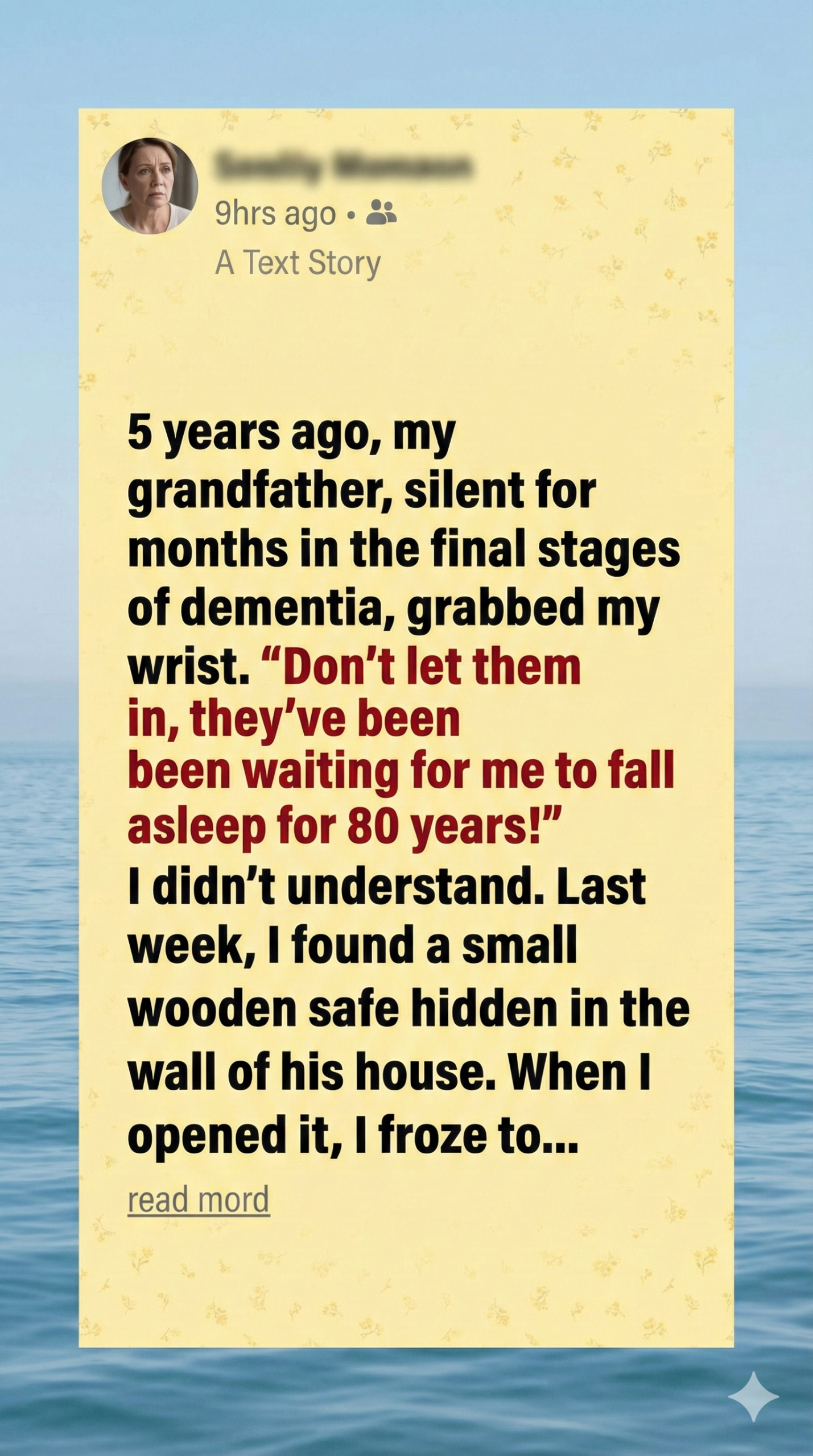
5 years ago, my grandfather — who hadn’t spoken in months because of late-stage dementia — suddenly grabbed my wrist with shocking strength.
His eyes were clear. Focused. Terrified.
“Don’t let them in,” he whispered. “They’ve been waiting for me to fall asleep for 80 years.”
Then he let go… and never spoke another coherent sentence again.
At the time, everyone said it was just confusion. Hallucinations. The mind unraveling.
I tried to believe that.
He passed away three months later.
Last week, while renovating his old house, I discovered something strange. Behind a loose panel in the hallway wall was a small wooden safe. No one knew it existed. Not my grandmother. Not my dad. No one.
The key wasn’t far — taped beneath a drawer in his old desk.
When I opened the safe, my stomach dropped.
Inside were old black-and-white photographs. Newspaper clippings. Letters tied with twine. And a military identification badge I had never seen before.
The badge wasn’t from the branch of service we thought he’d been in.
The letters were dated 1944.
They referenced a small unit stationed overseas — one that officially “never existed.” Several of the clippings described a classified incident that had been buried. A fire. A sealed building. “No survivors.”
Except one name had been blacked out in every article.
His.
At the bottom of the safe was a final envelope addressed to me.
“If you’re reading this,” it said, “it means I outlived them. But fear doesn’t die easily. What happened wasn’t an accident. We were told to keep quiet. Some of us did. Some didn’t.”
He wrote about an experiment. Something conducted in a remote facility near the end of the war. Something that went wrong. He claimed the building wasn’t destroyed to stop a fire — it was sealed to contain something.
“They said it was over,” he wrote. “But sometimes at night, I still see them in the hallway. Waiting. Watching. Making sure I stay quiet.”
The last line made my hands shake.
“If anyone ever comes asking about 1944… don’t let them in.”
I searched the unit name online.
There was almost nothing.
Just a few declassified fragments released decades later. And one sentence in a government archive:
“Subject relocated. Long-term monitoring recommended.”
Monitoring.
For 80 years.
Suddenly, his final words didn’t sound like dementia anymore.
They sounded like a warning.
That night, as I locked up the house, I noticed a black car parked across the street. It hadn’t been there earlier.
The engine was off.
But the headlights turned on.
And for the first time in my life…
I didn’t sleep.