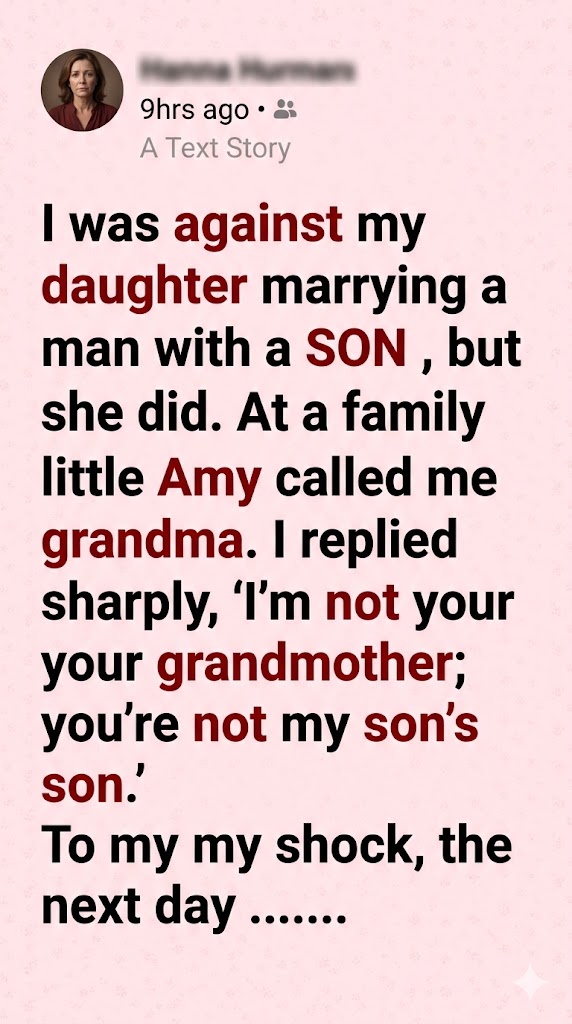
I was against my daughter marrying a man with a child, but she did. At a family lunch, little Amy called me grandma. I was so blinded by my own rigid expectations—and so used to doting only on my eldest boy’s children—that the words tumbled out as a cruel, nonsensical jumble. I replied sharply, “I’m not your grandmother; you’re not my son’s son.”
To my shock, the next day, my daughter Sarah’s car pulled into my driveway before the sun was even fully up.
I had spent the night convincing myself that Sarah would call to apologize for putting me in an uncomfortable position. Instead, she stepped out of her car holding a heavy cardboard box and walked up my front steps. She didn’t look angry. She looked utterly, terrifyingly indifferent.
She set the box down on my porch. Inside were the antique silver frames I had given her for her wedding, the embroidered quilt I’d made for her first home, and the spare key to her house.
“Sarah, what is this?” I asked, my voice trembling as the reality of the moment began to set in.
“It’s everything you’ve given me,” she said, her voice completely steady. “Mark and I sat up all night talking with Amy. She was crying, wondering why her new grandma hated her when she had tried so hard to be good. I realized I can’t force you to love my family, Mom. But I also absolutely refuse to let my daughter grow up in the shadow of your conditional love.”
“She’s not your daughter,” I blurted out defensively, though the words tasted like ash in my mouth. “She’s your stepdaughter.”
Sarah looked at me with a pity that cut deeper than any insult could have. “She is my daughter in every way that matters. I chose her, just like I chose Mark. If you can’t accept them, then you are choosing not to accept me. We won’t be coming to Sunday dinners anymore. Don’t call us until you are ready to be a grandmother to all of your grandchildren.”
She turned and walked back to her car, leaving me standing alone on the porch with a box of returned memories.
Later that afternoon, as I was putting the items away, a folded piece of construction paper slipped out from between the silver frames. I opened it. It was a crayon drawing of three stick figures—a man, a woman, and a little girl—holding hands with an older woman with gray hair. Above it, in messy, backward letters, it read: I love my completely new family. I stared at the drawing until my tears blurred the colors together. In my foolish pride and obsession with “bloodlines,” I had built a wall to keep a child out, only to realize I had locked myself out of my daughter’s life. I reached for the phone, knowing that an apology wouldn’t fix everything overnight, but understanding for the first time that if I didn’t make the call, the silence in my house would last forever.