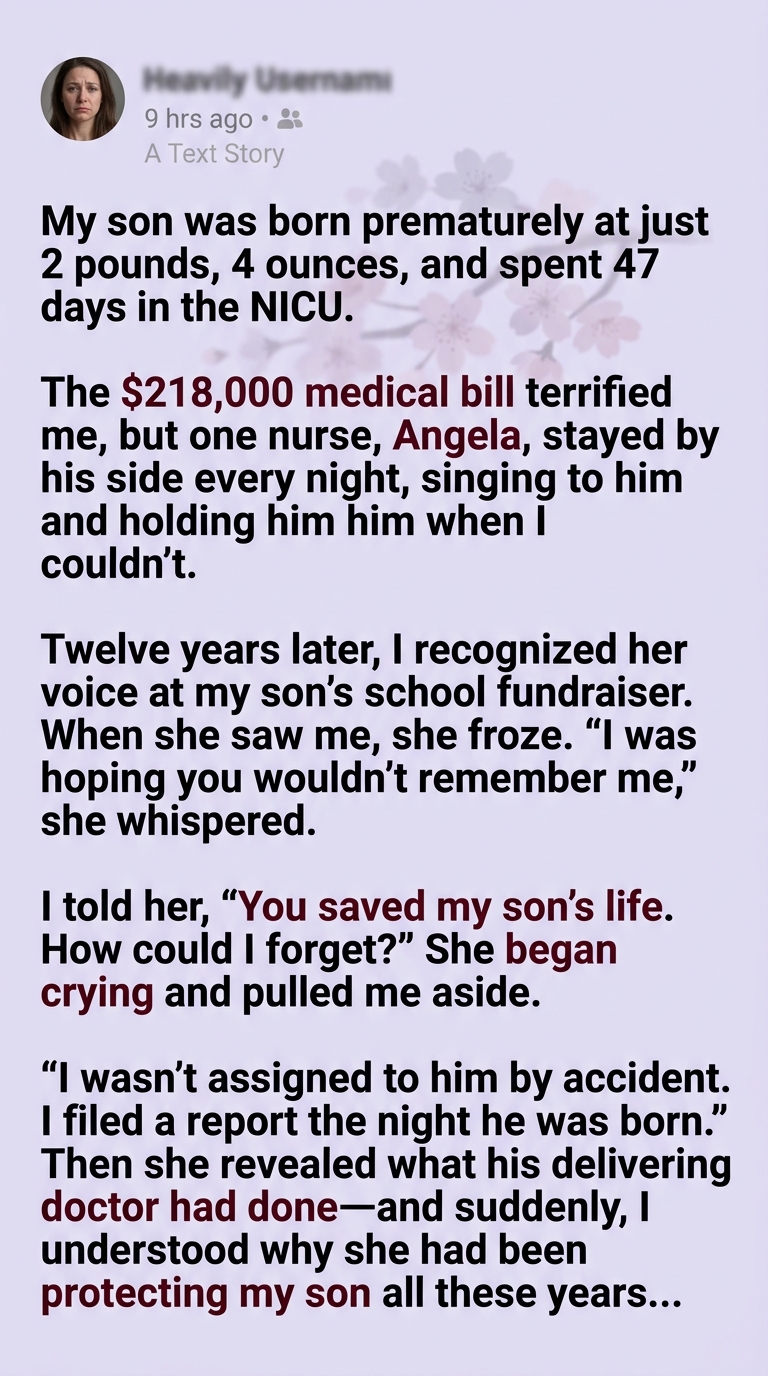
MY SON SPENT 47 DAYS IN THE NICU. TWELVE YEARS LATER, HIS FAVORITE NURSE REVEALED THAT SHE HAD FILED A REPORT THE NIGHT HE WAS BORN.
My son, Noah, was born weighing just 2 pounds, 4 ounces.
I still remember the silence in the delivery room.
He was so tiny that his entire body seemed to disappear beneath the hospital blankets. The doctors moved quickly, and within minutes, he was taken to the neonatal intensive care unit.
I barely had time to touch his hand.
For the next 47 days, the NICU became my second home.
The medical bills eventually reached $218,000. Even with insurance, the financial pressure was terrifying. I worried about how we would pay for everything, but my biggest fear was that my little boy might not survive.
One nurse made those 47 days bearable.
Her name was Angela.
She worked many of the overnight shifts. Whenever I arrived exhausted, she greeted me with a gentle smile.
She sang softly to Noah while checking his monitors. When I wasn’t allowed to hold him, she would place a comforting hand near his tiny fingers.
Sometimes, she would tell him stories.
“Your mommy is coming back, sweetheart,” she would whisper. “She’s just getting some rest.”
I remember one night when I broke down beside his incubator.
“I don’t know if I’m strong enough for this,” I told her.
Angela pulled a chair beside me.
“You don’t have to be strong every minute,” she said. “You just have to keep loving him. We’ll take care of the rest together.”
I never forgot those words.
Noah survived.
After 47 days, we finally carried him home.
He grew slowly, had regular medical appointments, and eventually became a healthy, energetic little boy.
Every year on his birthday, I thought about the nurses who had helped him survive.
Especially Angela.
But after we left the hospital, I never saw her again.
Twelve years passed.
Then, at a school fundraiser, I heard a familiar voice behind me.
It was singing softly to a group of children.
I turned around.
Angela.
She looked older, of course, but I recognized her immediately.
“Angela?”
She turned.
For a moment, she didn’t move.
Then her eyes widened.
“Oh my goodness.”
I walked toward her.
“You saved my son’s life. How could I ever forget you?”
She smiled, but her expression quickly changed.
“I was hoping you wouldn’t remember me.”
I frowned.
“What do you mean?”
She glanced toward the children and asked whether we could speak privately.
We walked into a quiet hallway.
She looked nervous.
“I need to tell you something about the night Noah was born.”
My heart began beating faster.
“What happened?”
Angela took a deep breath.
“I wasn’t assigned to him by accident. I filed a report that night.”
I stared at her.
“Why?”
She looked down.
“Because I was concerned about something your delivering doctor had done.”
I felt the floor shift beneath me.
Angela explained that the obstetrician who had delivered Noah had been unusually dismissive of the signs that labor was progressing too quickly.
She remembered that I had reported severe pain and pressure earlier than expected. She also recalled that the fetal monitoring had raised concerns that needed immediate attention.
According to Angela, the doctor had initially documented the situation as routine.
But Angela believed the records didn’t accurately reflect what she had witnessed.
She had raised concerns with the charge nurse and filed an internal patient-safety report.
I felt sick.
“Are you saying the doctor ignored something?”
“I’m saying I was concerned that the response was delayed and that the documentation didn’t match what I saw,” she replied. “I can’t tell you exactly what caused Noah’s premature birth. That would require a medical review. But I didn’t want what happened that night to disappear from the record.”
I swallowed hard.
“What happened after you filed the report?”
Angela explained that the hospital reviewed the incident. She had been asked to provide a statement and was later assigned to Noah’s care because she had already become familiar with his condition.
She had continued documenting concerns throughout his NICU stay.
Then she said something that surprised me.
“Your doctor asked me not to discuss the report with you while Noah was receiving care. I was told it could create confusion and interfere with the review.”
I shook my head.
“But why didn’t you tell me afterward?”
Angela’s eyes filled with tears.
“Because I was afraid. I was a relatively junior nurse, and the hospital was conducting an internal investigation. I had been told to follow the proper reporting channels. I thought the family would eventually be informed through the official process.”
She paused.
“Then I changed hospitals. I never knew whether anyone had explained anything to you.”
I felt overwhelmed.
For twelve years, I had believed Noah’s early arrival was simply one of those terrible medical surprises that sometimes happen.
Now I was learning that a nurse had raised concerns about how the delivery had been handled.
I asked her whether she still had the report.
She said she had retained her own professional notes but didn’t have access to the hospital’s official records anymore.
She also warned me that she couldn’t disclose another patient’s medical information or provide confidential hospital documents without proper authorization.
I thanked her for telling me.
Then I asked the question that had been bothering me.
“Why tell me now?”
Angela wiped her eyes.
“Because I saw Noah’s name on the fundraiser program. I recognized it immediately. I saw how healthy and happy he looked, and I realized I had never told you why I had fought so hard to make sure his care was documented.”
She looked directly at me.
“I wanted you to know that someone had noticed.”
I hugged her.
But I couldn’t stop thinking about the report.
That evening, I told my husband what Angela had said.
He was stunned.
“Do you remember anything unusual about the delivery?” he asked.
I closed my eyes.
I remembered the pain.
I remembered asking whether something was wrong.
I remembered a doctor telling me that everything was under control.
Then I remembered being rushed into an emergency procedure.
I had never received a detailed explanation afterward.
The following morning, I contacted the hospital’s medical records department.
I requested my delivery records, Noah’s NICU records, and any patient-safety documentation that I was legally entitled to receive.
The hospital explained that some internal incident reports were handled separately from ordinary medical records and might not be directly available through a standard records request.
I contacted a medical malpractice attorney for guidance.
The attorney explained that we needed to establish what had happened, whether the care met the appropriate medical standard, and whether any delay had caused preventable harm.
Because twelve years had passed, the attorney also warned me that legal deadlines could be complicated and depended on the applicable laws and circumstances.
I didn’t want to make accusations based on one conversation.
I wanted answers.
The records arrived several weeks later.
They showed that Noah had experienced serious complications around the time of delivery. They also documented an emergency response and his transfer to the NICU.
However, the records alone didn’t establish that the doctor had caused his premature birth or that any particular decision had caused his complications.
My attorney arranged for an independent medical expert to review the timeline.
During that review, we learned that Angela’s report had been entered into the hospital’s patient-safety system.
It had raised questions about the timing of clinical escalation and whether the documentation fully reflected the concerns raised by nursing staff.
The hospital had conducted an internal review, but the available summary did not answer every question.
I requested clarification through the proper channels.
The hospital eventually acknowledged that the concerns had been reviewed and that its procedures had been updated in response to broader patient-safety findings.
It did not make a formal admission that the doctor had caused Noah’s condition.
The medical expert’s review also found that the records were insufficient to conclude that a different response would certainly have prevented Noah’s premature birth.
That was difficult to accept.
I wanted a simple explanation.
I wanted someone to tell me exactly why my son had arrived so early and whether something could have been done differently.
But medicine doesn’t always offer simple answers.
What I did learn was that Angela had taken her responsibilities seriously.
She had documented what concerned her, raised the issue through the proper channels, and continued caring for Noah when he needed someone to advocate for him.
A few weeks later, I invited her to our home.
Noah was now twelve, tall enough to reach the kitchen cupboards, and full of questions.
When I introduced them, Angela immediately began crying.
“This is the little boy I used to sing to,” she said.
Noah looked confused.
“You sang to me?”
She smiled.
“Every night I could.”
He hugged her.
Then he asked something that made both of us laugh.
“Did I cry a lot?”
Angela laughed through her tears.
“You had quite a voice for someone so small.”
We spent the afternoon looking through old photographs.
There was one picture of Noah inside his incubator, with Angela’s hand gently resting beside his tiny fingers.
She stared at it for a long time.
“I remember that night,” she whispered.
I took her hand.
“Thank you for never treating him like just another patient.”
She shook her head.
“He was never just another patient.”
Today, Noah knows that he was born early and spent 47 days in intensive care. As he grows older, I’ll explain more about the medical review in an age-appropriate way.
I won’t teach him to hate a doctor based on questions that were never fully answered.
But I will teach him something important.
When you see something that doesn’t seem right, you should speak up.
And when someone is vulnerable, they deserve to have someone willing to stand beside them.
Angela did that for my son.
For twelve years, I remembered her as the nurse who sang to a tiny baby.
Now I remember something else.
She was also the nurse who refused to stay silent when she believed something needed to be examined.
My son survived because of many people. But one nurse made sure that his little life was never treated as just another medical record.