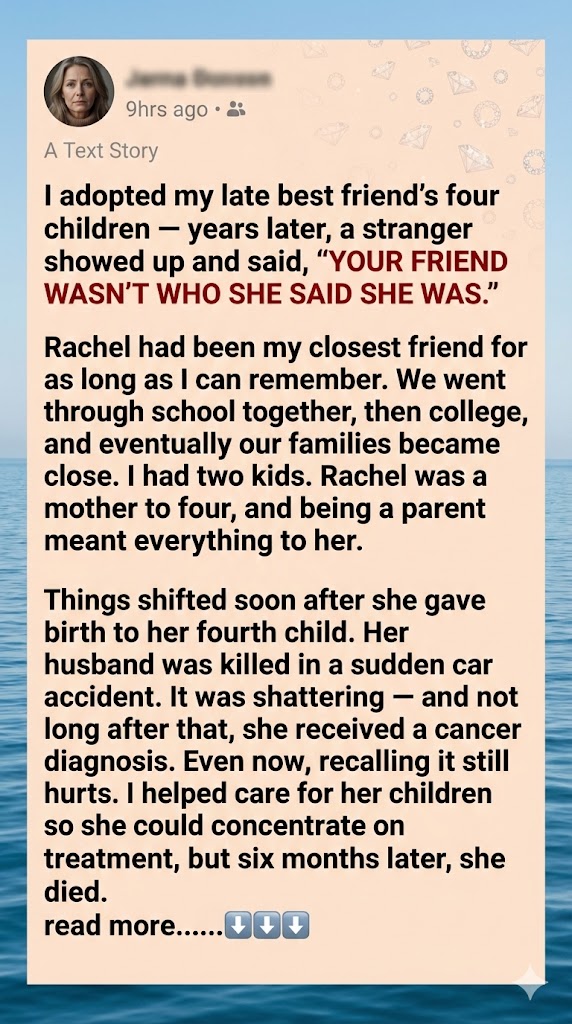
Six months later, she died.
In the final weeks, she made me promise something.
“If anything happens to me,” she whispered from her hospital bed, her hand frail in mine, “don’t let them be split up.”
I promised.
At the time, I didn’t realize that promise would redefine my entire life.
After she passed, the children’s biological grandparents were either gone or unable to take them in. Distant relatives talked about separating them. The system loomed.
So my husband and I made the decision.
We adopted all four.
Overnight, we went from a family of four to a family of eight.
It was chaos. Beautiful, exhausting chaos.
There were therapy appointments, grief outbursts, bedtime tears. The youngest would wake up calling for her mom. The oldest tried to act brave but carried anger like a shield.
But we made it work.
We blended birthday traditions. We kept Rachel’s photos up. We told stories about her constantly so her memory stayed alive, not frozen in tragedy.
Years passed.
They started calling me Mom on their own.
Not because I asked.
But because love grew in the spaces grief left behind.
Then one afternoon, nearly eight years later, a man knocked on my door.
Mid-fifties. Nervous. Holding a folder.
“Are you Rachel’s children’s guardian?” he asked.
“I’m their mother,” I replied carefully.
He hesitated.
“There’s something you need to know,” he said. “Your friend wasn’t who she said she was.”
My chest tightened.
He introduced himself as Daniel.
And then he said something that made the ground shift beneath me.
“I’m the biological father of the two youngest.”
I stared at him.
“That’s impossible,” I said. “Her husband—”
“Was infertile,” he interrupted gently. “Rachel and I… we had a relationship. It wasn’t supposed to become what it did.”
My head spun.
He opened the folder.
Inside were old messages. Photos. A paternity test request he had filed years ago but never pursued legally after her diagnosis.
“She told me she would handle it,” he said quietly. “Then she got sick. And then she was gone.”
Anger flared — not at him, but at the situation. At the secrecy.
“She told everyone her husband was the father,” I said.
“I know.”
He didn’t come with threats. He didn’t demand custody.
“I just wanted to know they were okay,” he said. “And if possible… maybe meet them.”
That night, I didn’t sleep.
I felt betrayed. Confused. Protective.
Had Rachel lied to me all those years?
Or had she been protecting something — or someone?
The next day, I called a lawyer.
Legally, the adoption was finalized years ago. Daniel had no automatic rights after so much time had passed and without prior legal action.
But law and morality aren’t always the same thing.
So I did something harder.
I talked to the kids.
Not all at once. Age-appropriate. Honest.
The two youngest were stunned. The older two were furious on their behalf.
“Are we leaving?” the youngest asked.
I pulled her into my arms.
“No,” I said firmly. “Nothing changes unless you want it to.”
After weeks of conversations and therapy sessions, the two youngest decided they wanted to meet Daniel.
The first meeting was cautious. Awkward.
But he didn’t try to replace anyone.
He didn’t call himself Dad.
He just answered questions.
Brought photo albums.
Showed up consistently.
Over time, a quiet relationship formed — supervised at first, then more relaxed. He attended school plays. Soccer games. Birthdays.
Not as a father replacing me.
But as a piece of their story that had been missing.
As for Rachel?
I had to reconcile two truths.
She was my best friend.
And she was flawed.
She made complicated choices in complicated grief. Maybe she thought she had more time to explain. Maybe she didn’t know how.
But one thing never changed:
She loved those children fiercely.
And so do I.
Family, I’ve learned, isn’t built on perfect stories.
It’s built on who stays.
And we all stayed.