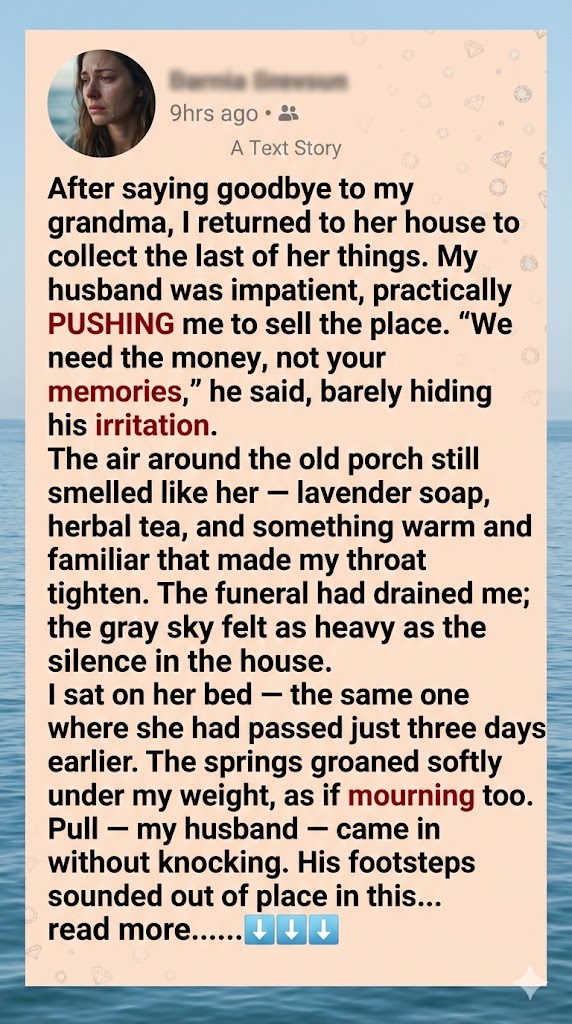
…in this house that still felt like hers.
“Are you done?” he asked, scanning the room like it was already a listing.
I wiped my face quickly. “Almost.”
He sighed dramatically. “We should call the realtor today. The market’s good. We can finally pay off the credit cards.”
The way he said finally made it sound like my grandmother’s death was some kind of financial opportunity.
I stood up slowly. “This house isn’t just an asset.”
“It’s wood and land,” he snapped. “Sentiment doesn’t pay bills.”
I walked past him into the hallway. The wallpaper was peeling near the stairs. The carpet had a permanent dip where Grandma’s rocking chair used to sit. Every flaw held a memory.
In the kitchen, I opened the last drawer I hadn’t checked.
Inside was a small envelope with my name written in her shaky handwriting.
My heart started pounding.
I stepped outside onto the porch to read it alone.
My sweet girl,
If you’re reading this, I’m gone. I know you. You’ll feel pressure to let this house go. But I didn’t keep it all these years just to have it sold in a rush. I paid it off long ago. The deed is in your name. No debt. No liens. It’s yours — fully and freely.
And if anyone tries to tell you it’s “just a house,” remember: it’s also your safety net.
My hands trembled.
Paid off.
Fully mine.
No debt.
I walked back inside where my husband was already on the phone. “Yeah, probably list it next week—”
“Hang up,” I said calmly.
He frowned but ended the call.
“The house is paid off,” I told him. “Completely. She transferred it to me years ago.”
His expression shifted — not to relief.
To calculation.
“So we can sell it and keep everything.”
“No,” I said.
He blinked. “What?”
“We don’t need to sell it. We need budgeting. We need to stop overspending. And we need to stop acting like my grandmother’s death is a windfall.”
His jaw tightened. “You’re choosing a building over our future.”
“No,” I replied quietly. “I’m choosing security. And I’m choosing not to be rushed.”
For the first time, I saw something clearly — the way he had been pushing, not grieving. The way he had been irritated, not supportive.
That night, I stayed in the house alone.
I slept in her bed, listening to the creaks and the wind through the porch screens. And for the first time since the funeral, I didn’t feel empty.
I felt protected.
Over the next few months, I renovated the place slowly. I rented it out eventually — not because I was pressured, but because I decided to. The income paid off our debts without losing the house.
But something else changed too.
I started noticing how often my husband equated money with control. How often my emotions were labeled “impractical.”
And I realized something my grandmother had quietly prepared me for:
The house wasn’t just a safety net.
It was independence.
A year later, when our marriage finally cracked under the weight of deeper issues, I didn’t panic.
Because I had somewhere to land.
I moved into the house with a fresh coat of paint and her lavender soap still tucked in the bathroom cabinet.
And sometimes, in the quiet evenings, when the porch smells warm and familiar, I whisper thank you.
She didn’t just leave me a house.
She left me a way out.