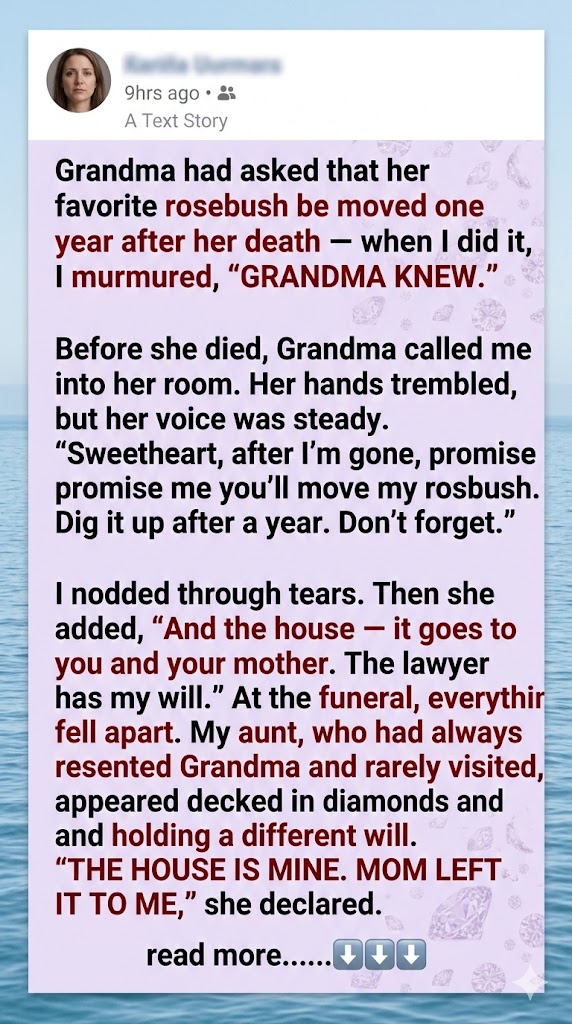
The room went silent.
My mother’s face drained of color. “That’s not possible,” she whispered. “Your mother told us—”
“The most recent will is what counts,” my aunt interrupted smoothly, waving the papers. “And this one is dated three months ago.”
Three months ago — when Grandma was already weak. When she could barely hold a pen without help.
I looked at my aunt’s manicured nails gripping the document and felt something cold settle in my chest.
The lawyer cleared his throat. “We’ll need to verify this.”
But my aunt was already smiling like she had won.
Within weeks, she changed the locks.
My mother and I were allowed to collect only “personal belongings.” Furniture, photo albums, even Grandma’s old china cabinet — all suddenly “assets.”
It didn’t feel like grief anymore.
It felt like theft.
The months dragged on. The will was tied up in legal review, but my aunt had temporary control of the property. She moved in. Parked her luxury car in Grandma’s driveway. Hosted loud gatherings that rattled the windows.
And through it all, I remembered Grandma’s words:
Dig it up after a year.
At first, I thought it was sentiment. Maybe she wanted her favorite rosebush replanted somewhere special.
But Grandma had never been vague without reason.
Exactly one year after she passed, I showed up early in the morning.
My aunt wasn’t home.
The rosebush sat along the side fence, blooming stubbornly, red petals bright against the soil.
I knelt down with a shovel, my hands shaking.
“GRANDMA KNEW,” I murmured.
The dirt was packed tight. It took effort to loosen the roots. After about a foot down, the shovel hit something solid.
Clink.
Not rock.
Metal.
My breath caught.
I dropped to my knees and started digging with my hands.
Buried beneath the roots was a small, rusted tin box sealed in plastic.
My heart pounded so loudly I could barely hear anything else.
Inside the box was another envelope.
And a flash drive.
The envelope was addressed in Grandma’s handwriting:
In case someone gets greedy.
My hands trembled as I opened it.
Inside was a notarized statement — signed and dated six months before her death — declaring that she had never altered her original will. It specifically mentioned my aunt by name and stated she feared “undue influence and document manipulation.”
There was also a copy of the original will.
And written at the bottom:
The house belongs to my daughter and granddaughter. I trust you to do what’s right.
My chest tightened.
The flash drive contained something even stronger.
Video.
Grandma, sitting in her living room chair, weak but clear-eyed.
“If you’re watching this,” she said into the camera, “someone has tried to change my wishes. I have not signed any new will. If papers appear saying otherwise, they are false.”
She even held up that day’s newspaper for proof of date.
Grandma hadn’t just suspected.
She had prepared.
I went straight to the lawyer.
Two months later, the forged will was officially declared invalid.
Handwriting experts confirmed the signature discrepancies. The witness names didn’t match verified records. The notary stamp was fraudulent.
My aunt didn’t just lose the house.
She faced charges.
The day we got the keys back, my mother stood in the doorway and cried softly.
I walked to the side yard.
The rosebush, now replanted carefully in the front garden, caught the sunlight.
Grandma hadn’t asked me to move it for sentiment.
She had hidden the truth where only someone patient — someone who listened — would find it.
She knew greed would bloom quickly.
But she also knew roots run deeper.
And she made sure the right ones survived.