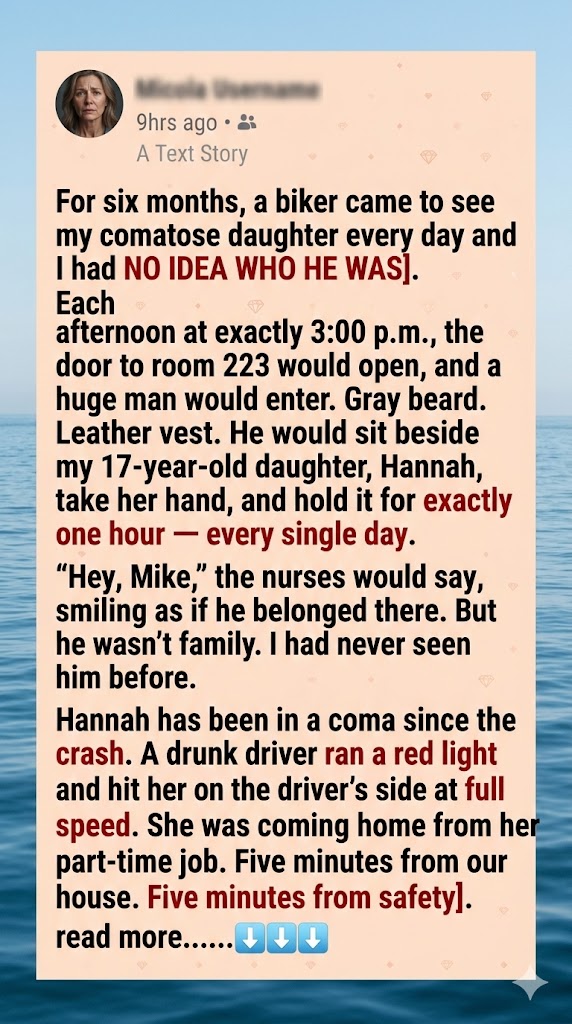
Five minutes from safety.
That’s what haunted me.
Every day at 2:55 p.m., I’d tense up.
And at exactly 3:00, like clockwork, the door would open.
The biker — Mike, apparently — would nod at the nurses, pull a chair close to Hannah’s bed, and take her hand.
He never brought flowers.
Never made a scene.
He just talked.
About the weather. About a dog he used to have. About a road trip he once took along the coast. His voice was low and steady, like he wasn’t speaking to a coma patient — just to someone resting.
I watched him for weeks before I finally gathered the courage.
One afternoon, as he stood to leave, I stepped in front of him.
“Who are you?” I asked.
His eyes softened immediately.
“I’ve been meaning to talk to you,” he said.
We stepped into the hallway.
“I’m Mike,” he repeated, extending his hand.
“I know your name,” I said quietly. “I don’t know why you’re here.”
He took a slow breath.
“Six months ago,” he began, “I was riding through that same intersection.”
My chest tightened.
“I was two cars behind the drunk driver.”
The air left my lungs.
“I saw him blow the red light. I saw the impact.”
My knees nearly gave out.
“I was the first one to reach her car,” he continued. “The driver’s side was crushed. I couldn’t open the door. So I climbed through the passenger side.”
His voice wavered for the first time.
“She was conscious for a minute. Barely. She kept saying she didn’t want to die.”
My heart shattered all over again.
“She grabbed my vest,” he said, looking down at it. “And she asked me if I thought her mom would be mad she was late.”
I covered my mouth.
“I told her no. I told her her mom would just be glad she was coming home.”
Tears streamed down my face.
“She squeezed my hand,” he whispered. “And then she stopped responding before the ambulance arrived.”
I had imagined those final moments a thousand times.
I had never imagined she wasn’t alone.
“I come because…” he swallowed hard. “Because I told her she wasn’t alone. And I don’t break promises.”
The hallway felt impossibly quiet.
“You don’t have to keep coming,” I said through tears.
He shook his head. “I know. I want to.”
“Why exactly one hour?”
He gave a faint smile.
“That’s how long it took the paramedics to cut her out of the car. I sat beside her that whole time.”
After that day, I stopped watching him with suspicion.
I started sitting with him.
He’d tell Hannah stories from his youth — the mistakes he made, the miles he rode, the people he lost. He’d play old rock songs softly from his phone because the nurses said familiar sounds can help.
And something shifted.
Not dramatically.
Not like in the movies.
But one afternoon, as Mike was telling her about a stubborn motorcycle that wouldn’t start, Hannah’s fingers twitched.
We both froze.
“Did you see that?” I whispered.
The nurse rushed in.
A week later, she squeezed his hand.
Two weeks after that, she opened her eyes.
The first word she tried to form was faint.
“Mom.”
The second word came out rough and broken.
“Mike.”
He turned away quickly, pretending to adjust his vest.
Recovery was slow. Painful. Miraculous.
When she was strong enough to speak clearly, she told us what she remembered.
“I thought I was dying,” she said. “And then I saw this big guy with a beard telling me bad jokes. I figured if that was my guardian angel, I’d be okay.”
Mike laughed so hard he cried.
The day Hannah was discharged, he didn’t come in at 3:00.
Instead, he waited outside the hospital on his motorcycle.
When she stepped out in her wheelchair, sunlight hitting her face, he removed his helmet.
She smiled at him like she’d known him her whole life.
Because in a way, she had.
He wasn’t family by blood.
He was family by promise.
And sometimes, that’s stronger.