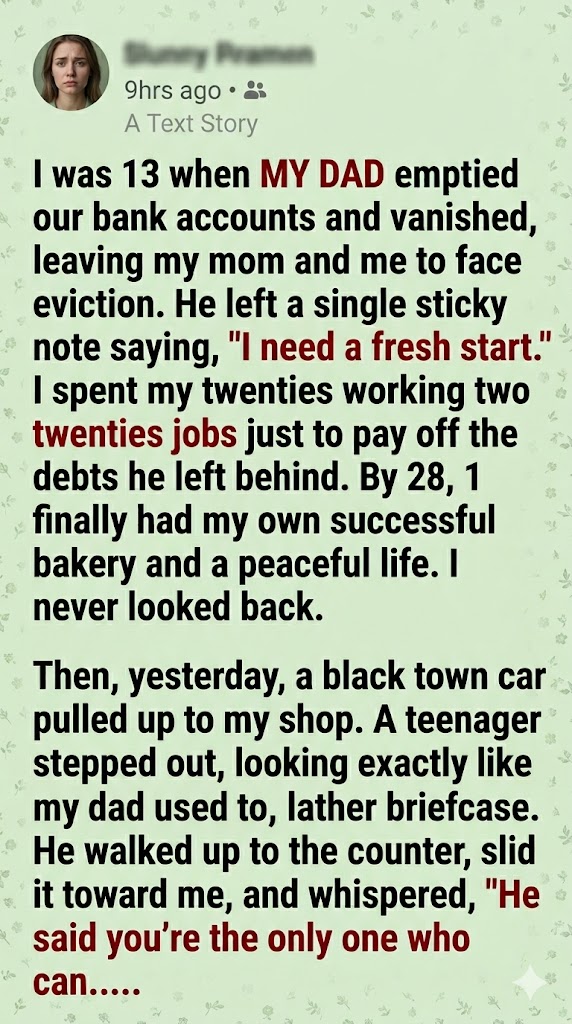
“…make this right.”
The words hung in the air, heavy and suffocating, mingling with the warm scent of cinnamon and rising yeast in my bakery. I stared at the boy. He was shaking, though he tried valiantly to hide it. The resemblance was a gut punch—the same unruly dark hair, the same sharp jawline, the same gray eyes that had coldly looked past me on his way out the door fifteen years ago.
“Who are you?” I asked, my voice dangerously calm as I wiped flour from my hands onto my apron.
“I’m Leo,” he said, swallowing hard. “Your… your brother.”
The world tilted on its axis. A brother. A whole other life built on the ashes of the one he burned down. I looked out the front window. The black town car was idling. The driver wasn’t getting out.
“Where is he?” I demanded.
“Gone,” Leo whispered, his gaze dropping to the floor. “Cancer. It was quick. He died last week.”
A strange, hollow silence echoed in my chest. I had spent fifteen years imagining the moment I would finally confront him. I’d practiced the screams, the accusations, the righteous fury. Now, the target of my anger was just a ghost, leaving me with a terrified teenager and a battered briefcase.
“He said to give this to you,” Leo continued, pushing the leather case closer to my side of the counter. “He said he spent his whole life running, but he couldn’t run from this. He said you were the strongest person he ever knew.”
My hands trembled as I reached out. The brass latches gave way with a heavy clack.
Inside, there were neatly banded stacks of hundred-dollar bills. Hundreds of thousands of dollars. Beneath the money lay a thick manila envelope containing the deed to a commercial property in the city, trust fund documents in my name, and… a single yellow sticky note.
My breath caught. The handwriting was messier, weaker, but unmistakably his.
The money is what I stole, with interest. The deed is my apology. The boy is my only good deed. I don’t ask for forgiveness, just that you don’t let him pay for my sins like you had to.
I stared at the note, the ghosts of my past roaring in my ears. I remembered the nights my mother cried over unpaid electric bills. I remembered scrubbing floors at midnight when I should have been studying. I remembered the bone-deep exhaustion of clawing my way out of the pit he threw us in.
I wanted to snap the briefcase shut, shove it back at the boy, and tell him to get out of my bakery. I wanted to tell him that his father’s debts couldn’t be paid with cash and a guilty conscience.
But then I looked up at Leo. He was thirteen. The exact age I was when my world was ripped apart. He stood there, orphaned, holding the weight of our father’s cowardice on his narrow shoulders, waiting to be turned away.
He left a thirteen-year-old behind to face the music. Again.
I felt a hot tear slide down my cheek, quickly followed by another. I wasn’t crying for the man who died. I was crying for the scared little girl I used to be, and the scared little boy standing in front of me.
I reached across the counter, past the briefcase full of blood money and guilt, and gently pushed a freshly baked chocolate croissant toward him.
“You look like you haven’t eaten all day,” I said softly.
Leo looked at the pastry, then up at me, his eyes brimming with tears he finally let fall. “I haven’t.”
“Eat,” I told him, closing the briefcase with a decisive snap. “Then we’re going to call that driver and tell him he can leave. You’re staying here.”
I couldn’t fix the past, and I would never forgive our father. But as I watched my little brother take a shaky bite of the croissant, I knew one thing for certain: the cycle of abandonment ended with me.