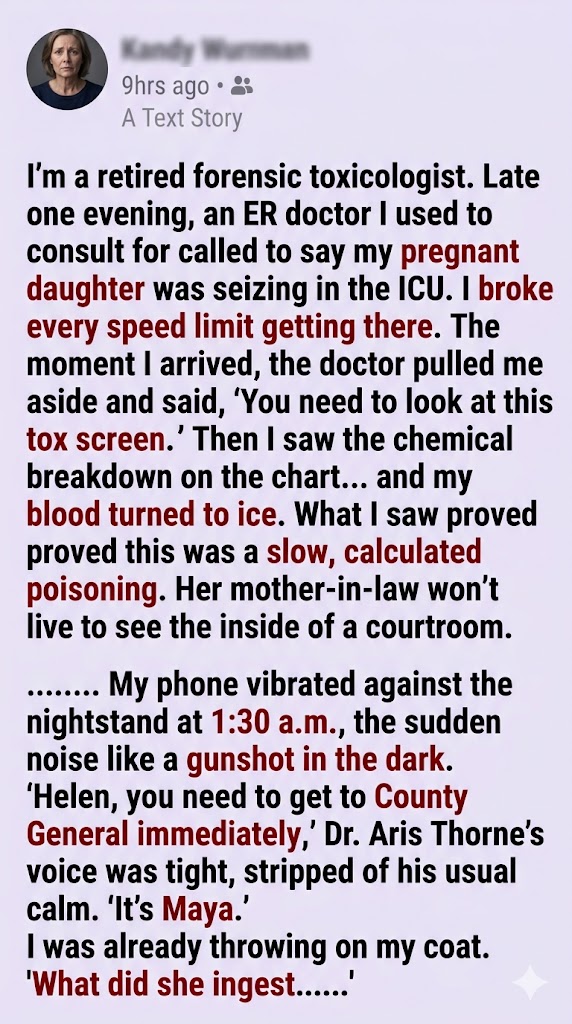
“We don’t know,” Aris replied, the background noise of the ICU bleeding through the receiver. “Her blood pressure is critical. The on-call OB thought it was severe early-onset eclampsia, but her liver enzymes are inverted, and her neurological responses are completely chaotic. Helen, the standard protocols aren’t working. Just get here.”
The drive to County General was a blur of rain-slicked asphalt and running red lights. My knuckles were white on the steering wheel, my mind frantically cycling through a mental Rolodex of toxins that could cross the placental barrier and trigger acute neurological failure.
When I burst through the double doors of the ICU, Aris was waiting. He didn’t waste time with pleasantries. He handed me the preliminary toxicology readout.
“I ordered a broad-spectrum heavy metals and volatile organics panel, just like you taught me,” Aris said quietly.
I scanned the rows of data, my eyes snapping to the anomalies. My blood turned to ice.
Thallium.
It was there, hiding behind a cascade of secondary metabolic failures. Thallium sulfate. Odorless, colorless, tasteless. It’s known in forensic circles as the “poisoner’s poison.” It is incredibly difficult to detect unless you are specifically looking for it, and it mimics a dozen other natural ailments.
Suddenly, Maya’s complaints over the last two months flooded my mind. The tingling in her fingers and toes, which her obstetrician had dismissed as pregnancy-induced carpal tunnel. The sudden, patchy hair loss, attributed to “hormonal shifts.” The constant, low-grade nausea.
It wasn’t a complicated pregnancy. It was a slow, calculated assassination.
“Start her on Prussian Blue immediately,” I ordered, my voice terrifyingly calm. “It’s the only antidote. It binds to the thallium in the digestive tract. You have to flush her system, Aris. Now.”
“We don’t have Prussian Blue on hand, Helen. I’ll have to get it couriered from the state tox center—”
“Do it,” I snapped. “Keep her seizing under control with barbiturates if you have to, but get that antidote.”
I walked to the glass window of Maya’s room. She looked so small, her heavily pregnant belly rising and falling in shallow, erratic gasps. I placed my hand against the cold glass.
Who?
Maya was an illustrator. She worked from home. She rarely went out. The only person who consistently brought her food, who insisted on “taking care” of her while my son-in-law, David, worked late hours… was Beatrice. David’s mother.
Beatrice, who had never hidden her disdain for Maya. Beatrice, who thought her wealthy, old-money family was too good for a public school art major. Beatrice, who, for the last three months, had been showing up twice a week with her special “maternal herbal teas,” sitting at the kitchen island and watching with hawkish eyes to ensure Maya drank every last drop.
To strengthen the baby, she had purred.
I turned away from the glass. The panic was gone, replaced by a cold, crystalline clarity that I usually reserved for the autopsy bay.
I left the hospital and drove to my old home laboratory. I still kept a locked, climate-controlled safe of reference standards from my consulting days. I didn’t reach for anything traceable. I reached for a purified, synthetic analogue of Aconitine—the active neurotoxin found in monkshood. It causes massive, immediate ventricular fibrillation. To a standard medical examiner, it looks exactly like a sudden, catastrophic heart attack. It leaves the blood within hours.
By 5:00 a.m., I was standing on the porch of Beatrice’s sprawling suburban estate. I let myself in with the spare key Maya had given me for emergencies.
Beatrice was in her immaculate kitchen, fully dressed, sipping espresso. She didn’t look like a woman who had been woken up by a frantic call from her son. She looked like a woman who had been awake all night, waiting for the final, tragic news.
She jumped when I stepped into the light. “Helen! What on earth are you doing here? David called me, he said Maya is—”
“Maya is going to live,” I said, stepping closer.
Beatrice’s eyes widened, a microscopic flash of disappointment and terror passing over her perfectly manicured features before she masked it with relief. “Oh, thank God. I’ve been sick with worry.”
“No, you haven’t,” I said smoothly. I closed the distance between us. “Thallium is a sloppy choice, Beatrice. It takes too long. Gives people like me time to figure it out.”
The color drained from her face. “I have no idea what you’re talking about. I’m calling the police.” She reached for the phone on the counter.
I grabbed her wrist. I am ten years younger than her, and fueled by a mother’s rage. I pinned her against the marble countertop. With my free hand, I pulled the pre-loaded auto-injector from my pocket.
“You think your money will protect you,” I whispered, pressing the device against the side of her neck. “You think you’ll hire expensive lawyers, claim it was an accident, or drag my daughter through a grueling trial while she tries to raise her child.”
“Helen, please—” Beatrice gasped, her eyes darting in absolute panic.
“I spent thirty years putting people like you in prison, Beatrice. But you? You don’t get a courtroom.”
I pressed the button. The compressed air hissed, driving the micro-dose of Aconitine directly into her carotid artery.
I released her and stepped back. Beatrice gasped, clawing at her neck, though there was no puncture wound, only a tiny red welt.
“What… what did you…” she wheezed, her chest already heaving as the arrhythmia took hold.
“A massive myocardial infarction,” I replied, watching clinically as her knees buckled. “Brought on by the shocking, tragic news of your daughter-in-law’s hospitalization. It’s a very poetic end.”
She collapsed onto the kitchen tiles, clutching her chest, her lips turning a faint shade of blue. I stood over her, feeling nothing but the sterile satisfaction of a successfully closed case. I watched the second hand on my watch. Forty-five seconds.
When her breathing stopped entirely, I picked up her overturned espresso cup, placed it neatly in the sink, wiped down the counter where I had touched it, and walked out the back door into the breaking dawn.
My phone buzzed as I started my car. It was Aris.
“Helen,” he sounded exhausted, but lighter. “The Prussian Blue is working. The seizures have stopped. The baby’s heart rate is stabilizing.”
“Thank you, Aris,” I said softly, pulling out of the driveway. “I’ll be right there. I just had to run a quick errand.”