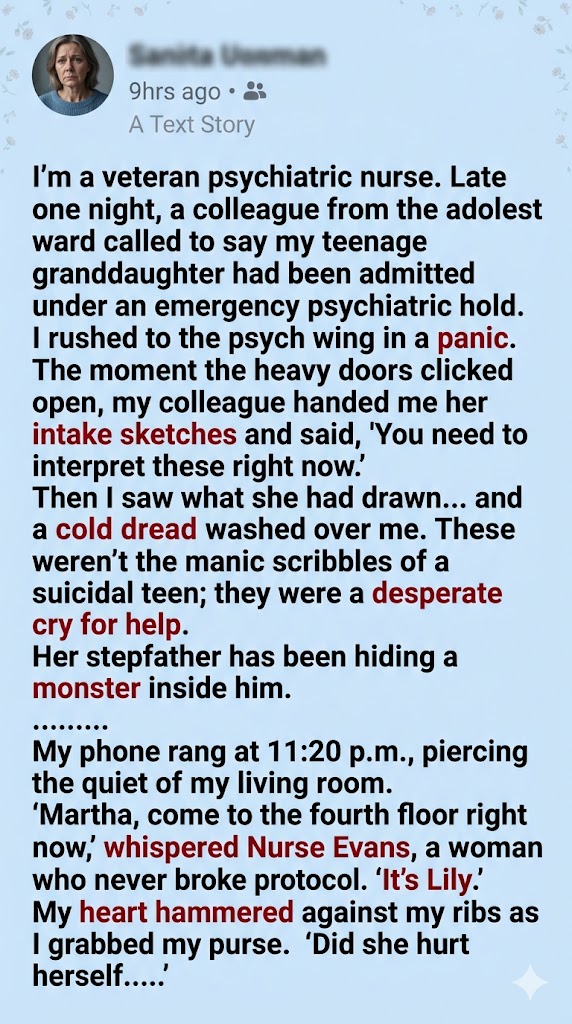
My phone rang at 11:20 p.m., piercing the quiet of my living room. “Martha, come to the fourth floor right now,” whispered Nurse Evans, a woman who never broke protocol. “It’s Lily.”
My heart hammered against my ribs as I grabbed my purse. “Did she hurt herself?”
“Just get here. Quickly,” Evans replied, her voice taut before the line went dead.
I’m a veteran psychiatric nurse. I know the sounds, the smells, and the very texture of a mental health crisis. But when it’s your teenage granddaughter admitted under an emergency hold, every ounce of professional detachment evaporates. I sped to the hospital, taking the stairs to the psych wing in a blind panic.
The moment the heavy doors clicked open, Evans was waiting. She didn’t offer a comforting hug or the usual platitudes. Instead, she thrust a charcoal-smudged sketchbook into my hands.
“She refused to speak to the admitting doctor,” Evans said quietly. “She just kept drawing. When she finished, she looked at me and said, ‘Give this to Nana.’ You need to interpret these right now.”
I opened the book. Then I saw what she had drawn… and a cold dread washed over me. These weren’t the manic scribbles of a suicidal teen; they were a desperate, calculated cry for help. Her stepfather, David, had been hiding a monster inside him.
The first page wasn’t an expression of depression—it was a precise, architectural cross-section of my daughter’s home. Lily had detailed the living room, the kitchen, and the attached garage. But beneath the garage, drawn in heavy, aggressive charcoal strokes, was a sub-basement that didn’t exist on any city blueprint. She had meticulously sketched soundproofing panels, a heavy steel door, and a padlock. Beside the lock, masquerading as a random geometry equation, was a four-digit combination: 0-4-1-9. My daughter’s birthday.
I flipped to the second page. It was a drawing of my daughter, Sarah, asleep in her bed. On her nightstand was a crushed blister pack of pills. Looming in the doorway was a shadowy figure with David’s distinct posture, holding what looked like a veterinary syringe.
The third page was a self-portrait of Lily, curled in the corner of that soundproof cinderblock room. Written beneath it in tiny, cramped handwriting were the words: He says the cement will be dry by Friday.
Today was Thursday.
“She didn’t try to kill herself, Martha,” Evans whispered, reading the horror on my face. “She made a superficial cut on her arm during her last period at school today. Just enough blood to trigger a mandatory 72-hour psychiatric hold. She knew her mother couldn’t protect her. She knew David couldn’t touch her in a locked ward. She got herself committed to buy time.”
I handed the book back to Evans, my hands trembling with a lethal mixture of terror and pure, maternal rage. “Where is she?”
I found Lily sitting cross-legged on a sterile hospital cot. She looked so small in the standard-issue gown, but her eyes were sharp, devoid of tears.
“Nana,” she whispered, her voice barely carrying over the hum of the air conditioner. “He drugs Mom’s tea so she sleeps through the noise of the drilling. He told me that when the room is finished, I’m going to disappear.”
“You’re safe now, sweetie,” I said, gripping her hands. “I’m not letting him anywhere near you. And we aren’t waiting for morning.”
I didn’t call Child Protective Services—their bureaucratic wheels turned too slowly for a Friday deadline. Instead, I called Detective Miller, a seasoned investigator I had worked with on dozens of severe domestic trauma cases over my thirty-year career. I told him I had a credible threat, physical evidence, and a victim in protective custody.
By 2:00 a.m., three unmarked police cruisers rolled up to my daughter’s quiet suburban home.
I stayed in the car with my heart in my throat while Miller and his team breached the front door. Through the living room window, I saw the lights flick on. I saw my daughter, Sarah, being gently guided out of the house by a female officer, looking groggy, confused, and terrified. Then, I saw David.
He was in handcuffs, his charming, affluent-suburban-dad facade completely shattered. He was screaming about his rights, but the officers weren’t listening. Miller had gone straight to the garage. Underneath a heavy rubber mat and a false floorboard, just as Lily had drawn it, they found the steel door. They punched in 0-4-1-9.
When Miller walked back out to the driveway, his face was the color of ash. He looked at me through the windshield and gave a slow, grave nod. The room was real. The cement was still curing. And inside, they found a mattress and heavy-duty zip ties.
Lily’s intuition had saved her own life.
The next morning, I walked back through the heavy doors of the psychiatric ward. The sun was streaming through the reinforced windows. I sat on the edge of Lily’s bed and wrapped my arms around her.
“He’s gone,” I whispered into her hair. “He’s never coming back.”
For the first time since this nightmare began, the hardened, survivalist look in my granddaughter’s eyes melted away. She buried her face in my shoulder, and she finally allowed herself to cry. She had locked herself in a psych ward to escape a madman, proving that sometimes, the sanest thing you can do in a crazy world is ask for a padded room.