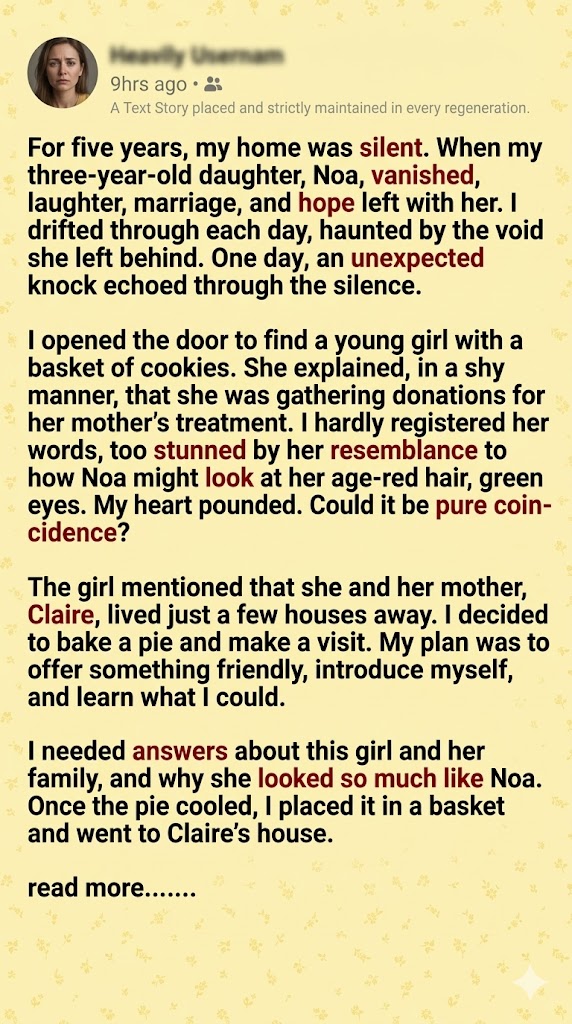
The walk down the street felt like wading through deep water. Every step was heavy with a chaotic mix of dread and fragile, dangerous hope. The neighborhood was familiar, yet the small, pale blue house at the end of the cul-de-sac suddenly looked like a fortress holding the answers to the last five years of my agony.
I knocked on the peeling front door, my knuckles white around the handle of the pie basket.
A woman answered. She looked frail, her skin possessing the translucent quality of the chronically ill, but she had a kind smile. “Can I help you?” she asked, her voice raspy.
“Hi, I’m from down the street,” I said, forcing a polite warmth into my voice. “Your daughter came by earlier with cookies. I wanted to welcome you to the neighborhood and bring you this pie.”
Her eyes softened. “That is incredibly kind of you. Please, come in. I’m Claire, and that little salesperson is Lily.”
I stepped into the modest living room. It was tidy but smelled faintly of medicinal rub and old paper. “Lily” was sitting at the kitchen table, drawing with crayons. As I set the pie down, she looked up, and the breath caught in my throat all over again. Up close, the resemblance wasn’t just striking; it was a mirror image of Noa’s father, mixed with my own features.
“Lily, say thank you to our neighbor,” Claire gently prompted.
“Thank you,” the girl chirped. As she reached out to slide a piece of paper across the table, her sleeve pulled back.
My heart stopped. There, just above her left wrist, was a small, pale birthmark shaped like a crescent moon. It was the exact mark I used to kiss every night before tucking Noa in.
I gripped the back of a kitchen chair to steady myself. “She’s beautiful,” I managed to whisper. “Does she… has she always lived here with you?”
Claire’s warm smile faltered. A shadow passed over her sunken eyes, and she clutched a dish towel nervously. “We moved here a few months ago to be closer to the clinic. It’s… just been the two of us for a long time.”
I couldn’t hold it back anymore. The polite neighbor facade crumbled. “Claire,” I said, my voice trembling but absolute. “Five years ago, my three-year-old daughter, Noa, went missing from the park a few miles from here. She had red hair, green eyes, and a crescent moon birthmark on her left wrist.”
The room plunged into a suffocating silence. The crayon snapped in Lily’s hand.
Claire stumbled backward, collapsing into a worn armchair. The color entirely drained from her face. She covered her mouth with trembling hands, tears spilling over her eyelashes. “No,” she choked out. “No, my husband… my late husband brought her home. He told me he found her wandering near the highway, abandoned. He told me the police had no leads… that she was meant to be ours. He wouldn’t let me ask questions. When he died two years ago, she was all I had left.”
I fell to my knees, the tears I had held back for half a decade finally breaking free. I wasn’t looking at Claire; I was looking at the little girl at the table, whose wide green eyes were staring back at me with a mix of fear and unrecognized familiarity.
“Her name is Noa,” I wept, reaching a shaking hand out toward her.
Claire didn’t fight me. The illness had stripped her of the strength to hold onto a lie she had likely suspected for years. Instead, she wept with me, the tragic realization washing over the room that her impending death had subconsciously driven her to this neighborhood—a twist of fate returning a stolen child to her rightful home before it was too late.
Slowly, the little girl slid out of her chair. She walked over to where I knelt on the linoleum floor, her small hand reaching out to touch my wet cheek.
“Why are you crying?” she whispered.
“Because,” I smiled, pulling her into a desperate, life-saving embrace, “I finally found my way home.”